
Published October 26, 2026Checked against the current regulations
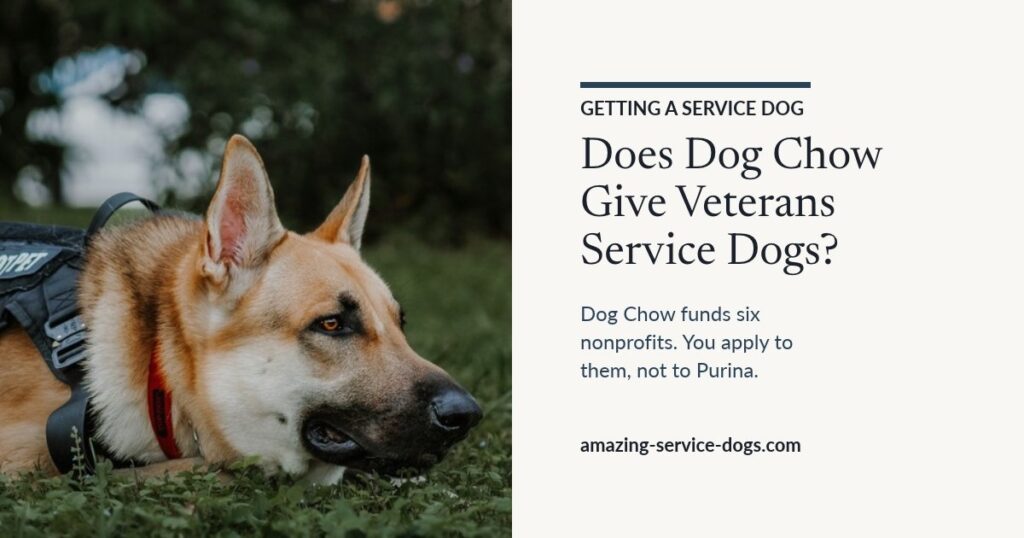
Does Dog Chow give veterans service dogs? No. Dog Chow service dogs for veterans come from six nonprofit trainers that Purina helps pay for, and you apply to those groups, not to Purina. There is no Dog Chow application for a veteran to fill out. The program is called the Dog Chow Service Dog Salute, and since 2018 it has given money to the groups that do the training. If you are still working out whether a service dog fits your situation at all, start with do I qualify for a service dog.
This page covers what Purina’s own pages say the program does, the six groups and who each one takes, the two that name military sexual trauma, what “free” still costs you, and who benefits from the ad being read the wrong way.
What the ad says, and what Purina’s own page says
The ad that started this page was a creator video on Facebook, run for Dog Chow, saying Dog Chow gives service dogs to veterans with an MST diagnosis. I am linking the original ad rather than copying it, because it belongs to Purina and the creator.
Purina’s program page says something narrower. In its words: “Since 2018, the Dog Chow Service Dog Salute program has been taking action to help more Veterans with a demonstrated need obtain a PTSD service dog.” The four things it lists are donating money (“$1.8 Million” and counting), advocating for legislation, supporting research and raising awareness. Handing a dog to a veteran is not on the list.
Purina’s own program page never uses the words “military sexual trauma” or “MST.” The MST part of the ad comes from two of the partner groups, covered below.
The honest one-line version, if you want to repeat it to someone: Dog Chow helps fund PTSD service dogs for veterans through its Service Dog Salute program. The dog comes from a nonprofit, and so does the application.
The six groups Dog Chow funds, and who each one takes
Purina’s facts page lists six partners. Here is what each group says about itself, or what Purina says about it.
| Group | What the group, or Purina, says | Names MST? |
|---|---|---|
| Got Your Six Support Dogs | Requires military or first responder service and a “verifiable” diagnosis of PTSD, TBI and/or MST that “must be service-related.” Training is 14 days in Maryville, Illinois | Yes |
| K9s For Warriors | Serves “military Veterans nationwide suffering from PTSD, traumatic brain injury, and/or military sexual trauma,” from all eras, “at no financial cost to the Veteran” | Yes |
| Northwest Battle Buddies | Purina says each dog gets “over 360 hours of rigorous training,” then “an additional five weeks of joint training” with the veteran | Not on Purina’s page |
| Operation Freedom Paws | Purina describes “a 48-week training program” and says the group has trained “over 580 service dog teams” | Not on Purina’s page |
| Semper K9 | Founded by a combat veteran. Purina quotes it as providing “custom-trained mental health and mobility service dogs free of charge” | Not on Purina’s page |
| Dog Tag Buddies | Founded in Billings, Montana. Purina describes “a two-year journey of healing, growth, and reconnection” | Not on Purina’s page |
I read the application pages for the first two myself. For the other four, the table is what Purina’s page says, and each group’s own rules may be stricter. Ask each one directly before you count on anything.
These are not the only groups that place dogs with veterans at no cost. Canine Companions, America’s VetDogs and others do too, and the side-by-side of who takes whom, the waits and the training you must attend is in how veterans get their own service dog.
If you have MST: the two groups that say it
Of the six, only Got Your Six Support Dogs and K9s For Warriors name military sexual trauma on their own pages.
K9s For Warriors says it serves veterans with “PTSD, traumatic brain injury, and/or military sexual trauma,” and that its dogs come “at no financial cost to the Veteran.” It serves “Veterans from all eras across the United States, the U.S. territories and the Philippines.” Applications go through apply.k9sforwarriors.org.
Got Your Six publishes its rules in detail, so here they are.
What Got Your Six asks of you
From the group’s apply page, read today:
- A verifiable diagnosis of PTSD, TBI and/or MST that “must be service-related,” plus a referral and your healthcare provider’s support
- “Verifiable participative sessions with a therapist, psychologist, or social worker on a monthly basis” for at least six months
- “No felony conviction, pending criminal charges, current parole/probation, pattern of criminality, or animal abuse”
- 14 days at their facility in Maryville, Illinois, completed “without a caregiver or assistance in activities for daily living”
- Lodging and most meals covered. Your transportation is on you
- After placement, the dog’s food, grooming, supplies and “annual veterinary exam, vaccinations” are on you, for the life of the dog
The steps they publish: mail the completed application (you have 60 days to finish it), a background check sent by email, an interview within 30 days, a home inspection, and word within three months of whether you were selected. Their stated wait after that: “the waiting time to receive a service dog is currently 1-2 years.”
What the dog actually does once it is trained is a separate question, and the trained tasks are in what PTSD service dogs do, and why the programs lean on certain breeds is in best service dog breeds for PTSD.
What “free” still costs you
Free for the dog does not mean free. Purina’s facts page puts the price on the training side: “It can cost training organizations upwards of $25,000 to train and place one service dog for a Veteran with PTSD.” It also says training “generally takes 18 – 24 months” and that service dog supply “is far outweighed by demand, making three-year wait times not uncommon.”
So the nonprofit carries the $25,000. You carry the travel to the training, the time away from home, and every bag of food and vet bill for the life of the dog. Dog Chow’s money helps the first part. It does not touch the second.
If you are weighing a free program against paying a trainer or training your own dog, the real numbers for each route are in how much does a service dog cost. Mr. Big, my retired service dog, did not come from a program. I trained him myself. That route is real, and it is not free either.
The laws Purina backs, and what they do
Purina’s facts page says Dog Chow supported the PAWS for Veterans Therapy Act, “signed into law in August of 2021.” The law is real. It is also widely misread. The text of the Act sets up a five-year pilot at “not fewer than five medical centers” that provides “canine training to eligible veterans diagnosed with post-traumatic stress disorder.” The veteran helps train a dog as part of their care. A veteran “may adopt a dog that the veteran assisted in training” if the veteran and their health provider agree it is in their best interest. It is a training program. It does not hand out dogs.
The VA’s own page is blunt: “VA does not provide service dogs for physical or mental health conditions, including PTSD.” The full VA picture, including the veterinary benefit some veterans can get, is in the veterans guide.
The second bill Purina names is the SAVES Act, which would have the VA give grants to nonprofits that train service dogs for veterans. Purina’s page cites the 2024 House version, H.R. 9525. The bill came back in the current Congress as S. 1441 and H.R. 2605, and the House Veterans’ Affairs Committee filed a report on it. A bill is not a benefit until it is signed. I could not open the official bill tracker from here today, so check congress.gov for where it stands before you plan around it.
Who benefits from you believing Dog Chow gives out dogs
Purina sells dog food. The Service Dog Salute raises money through the bags. In 2020, for example, Purina’s newsroom said Dog Chow would donate for every specially marked bag bought from September 1 through Thanksgiving, “up to a total of $100,000,” split between two groups. That is a real gift, and it has a ceiling. The ad’s version, where Dog Chow itself hands a veteran a dog, makes the bag sound like a ticket. It is not one.
Purina’s program page also says “PTSD service dogs are scientifically proven to reduce suicidal ideations and PTSD symptom severity in Military Veterans.” The VA’s National Center for PTSD says: “Currently, there is not enough research to know if dogs help treat PTSD and its symptoms.” I am not going to rank those two. They are both on the record, and you can read both. Whether a dog would help you is a question for you and whoever treats you.
None of this makes the six groups less real, or the money less useful to them. It just means the person who gets you a dog is a trainer at a nonprofit, after an application, an interview and a wait. Nobody at the grocery store.
What I do not know
- Whether the partner list has changed for 2026. Purina’s page lists six groups and does not date the list. I found no 2026 campaign announcement
- How much Dog Chow gives per bag. Purina publishes the cap for some years, not the per-bag amount
- The full written rules for Semper K9 and Dog Tag Buddies. I could not find them published
- Where the SAVES Act stands today. See above
The test before you look for a Dog Chow application
Ask yourself: who is going to train this dog, and have I read their application? If the answer is a brand name and not a nonprofit, you are reading an ad. Go to the group, read its rules in its own words, and ask for every cost in writing before you apply.
Frequently asked questions
Does Purina give service dogs to veterans?
No. Purina’s Dog Chow Service Dog Salute program gives money to six nonprofit trainers, and those groups place the dogs. Purina’s program page lists donating, advocating for legislation, supporting research and raising awareness. There is no application to Purina for a veteran to fill out.
How do veterans apply for a Dog Chow service dog?
You apply to one of the partner groups directly: Got Your Six Support Dogs, K9s For Warriors, Northwest Battle Buddies, Operation Freedom Paws, Semper K9 or Dog Tag Buddies. Each has its own rules, waits and training dates.
Which groups take veterans with MST?
Of the six groups Dog Chow funds, Got Your Six Support Dogs and K9s For Warriors name military sexual trauma on their own pages. Got Your Six requires a verifiable, service-related diagnosis. K9s For Warriors serves veterans of all eras with PTSD, TBI and/or MST at no cost to the veteran.
Is a Dog Chow service dog free?
The dog and the training are free to qualified veterans at the partner groups. You usually still pay your own travel to the training, and after placement you pay for the dog’s food, vet care and supplies for life. Purina says training one dog can cost the nonprofit upwards of $25,000.
Does the PAWS Act give veterans a service dog?
No. The PAWS for Veterans Therapy Act, signed in August 2021, set up a five-year VA pilot where veterans with PTSD help train dogs as part of their care. A veteran may adopt a dog they helped train if they and their health provider agree it is in their best interest, but that is not the purpose of the pilot.
I am a veteran and a service dog handler, not a lawyer and not a clinician, and nothing here is legal or medical advice. Every link above goes to the regulation, the agency or the study itself, so you never have to take my word for it.
Sources
Every source below was opened and re-read on 21 October 2026.
- Purina — Dog Chow Service Dogs for Veterans (Service Dog Salute program page)
- Purina — Facts and Benefits, with the partner list and legislation
- Purina newsroom — Purina Dog Chow Launches Third Annual Service Dog Salute Campaign (2020)
- Got Your Six Support Dogs — Apply for a Service Dog
- K9s For Warriors — Service Dogs for Veterans
- U.S. Government Publishing Office — Public Law 117-37, the PAWS for Veterans Therapy Act
- U.S. Government Publishing Office — Congressional Record Index, Service Dogs Assisting Veterans (SAVES) Act, 2025
- U.S. Department of Veterans Affairs, National Center for PTSD — Dogs and PTSD