
Published October 27, 2026Checked against the current regulations
Antifreeze poisoning in dogs is a race against a clock that starts before the dog looks sick. Most car antifreeze is ethylene glycol, it tastes sweet, and the Merck Veterinary Manual puts the minimum lethal dose for a dog at 4.4 to 6.6 mL of the undiluted liquid per kilogram of body weight. Pet Poison Helpline says dogs should get the antidote within 8 to 12 hours of drinking it, and cats within 3. A poisoned dog can look better partway through that window. So the call to the vet comes the moment you suspect it.
It sits in Service Dog Health beside my notes on working dog nutritional requirements, because what goes into a working dog’s mouth is part of the job. This page covers why dogs drink it, how little it takes, what the stages look like, what the veterinary sources say to do first, and the part of the bitter taste and “pet safe” story that tends to get left out. I am a handler, not a vet. Every medical line here comes from a veterinary source, and they are all listed at the end.
Why a dog drinks antifreeze
VCA Animal Hospitals describes ethylene glycol as “a sweet-tasting, odorless liquid.” Concentrated antifreeze is strong stuff: the Merck Veterinary Manual says concentrations “up to 95% are common,” and the coolant in a car’s radiator is usually that concentrate cut about half and half with water. Ready-to-use 50/50 jugs are sold too.
Antifreeze is the big source, not the only one. Merck lists some brake and transmission fluids and the heat-exchange fluids in solar collectors and ice-rink equipment. VCA adds lower amounts in some windshield de-icers, brake fluid and motor oils.
Pet Poison Helpline names where pets actually find it: leaking vehicles, containers in garages and storage sheds, winterized RV plumbing including toilets, and vehicle fluids that were dumped where they should not have been.
Now think about where a service dog spends the day. A working dog goes where the handler goes: parking lots, gas stations, the tire shop, a friend’s garage, the rest stop on a road trip. Mr. Big went everywhere with me, into Canada and all over the United States. That is a lot of pavement under a lot of parked cars. A backyard dog sees one driveway. A working dog sees hundreds. If you travel with your dog, the rules for each kind of trip are in traveling with a service dog, and the parked car question has its own page: can you leave a service dog in the car.
At home I have five dogs on almost ten acres, a garage with a table saw and a planer, and a marked gas can for the chainsaw. Every one of those is a place a jug can sit and a drip can land.
How little antifreeze it takes to poison a dog
The Merck Veterinary Manual gives the number: “The minimum lethal dose of undiluted ethylene glycol is 1.4 mL/kg in cats, 4.4–6.6 mL/kg in dogs.”
The American Kennel Club quotes its chief veterinary officer, Dr. Jerry Klein, in kitchen units: “Ingesting as little as half a teaspoon per pound of a dog’s body weight can result in fatality.”
Milliliters per kilogram mean nothing standing in a garage, so I did the arithmetic. This table is my math from the Merck range, nothing more. It is not a dosing guide and it is not a safe amount. It is there so you can see the size of the problem.
| Dog’s weight | Undiluted ethylene glycol (Merck range) | 50/50 coolant (about double) |
|---|---|---|
| 20 lb | about 3 to 4 tablespoons | about 1/3 to 1/2 cup |
| 50 lb | about 7 to 10 tablespoons | about 7/8 cup to 1 1/4 cups |
| 70 lb | a little over 1/2 cup to just under 1 cup | about 1 1/4 to 1 3/4 cups |
| 90 lb | about 3/4 cup to 1 1/8 cups | about 1 1/2 to 2 1/4 cups |
Same arithmetic for a cat: a 10-pound cat at Merck’s 1.4 mL/kg is about 6 mL of undiluted ethylene glycol, roughly a teaspoon and a quarter. If you have a barn cat or a house cat along with your dogs, they are on a much shorter clock.
Two things about that table. First, the “about double” column assumes a straight 50/50 mix, so it is rough. Second, AKC’s half teaspoon per pound lands inside the Merck range for a 70-pound dog, at about 35 teaspoons. The two sources agree.
What antifreeze poisoning in dogs looks like, stage by stage
The veterinary sources describe three stages. The timing is from Pet Poison Helpline and the AKC, with the kidney timing confirmed in Merck.
| Stage | When | What the vets describe |
|---|---|---|
| 1 | 30 minutes to 12 hours | Looks like the dog got into alcohol: staggering, vomiting, drooling, drinking and peeing a lot, sometimes seizures |
| 2 | About 12 to 24 hours | The dog can seem to get better. Damage inside keeps going |
| 3 | Dogs 36 to 72 hours, cats 12 to 24 hours | Sudden kidney failure: little or no urine, and many dogs at this stage die (AKC) |
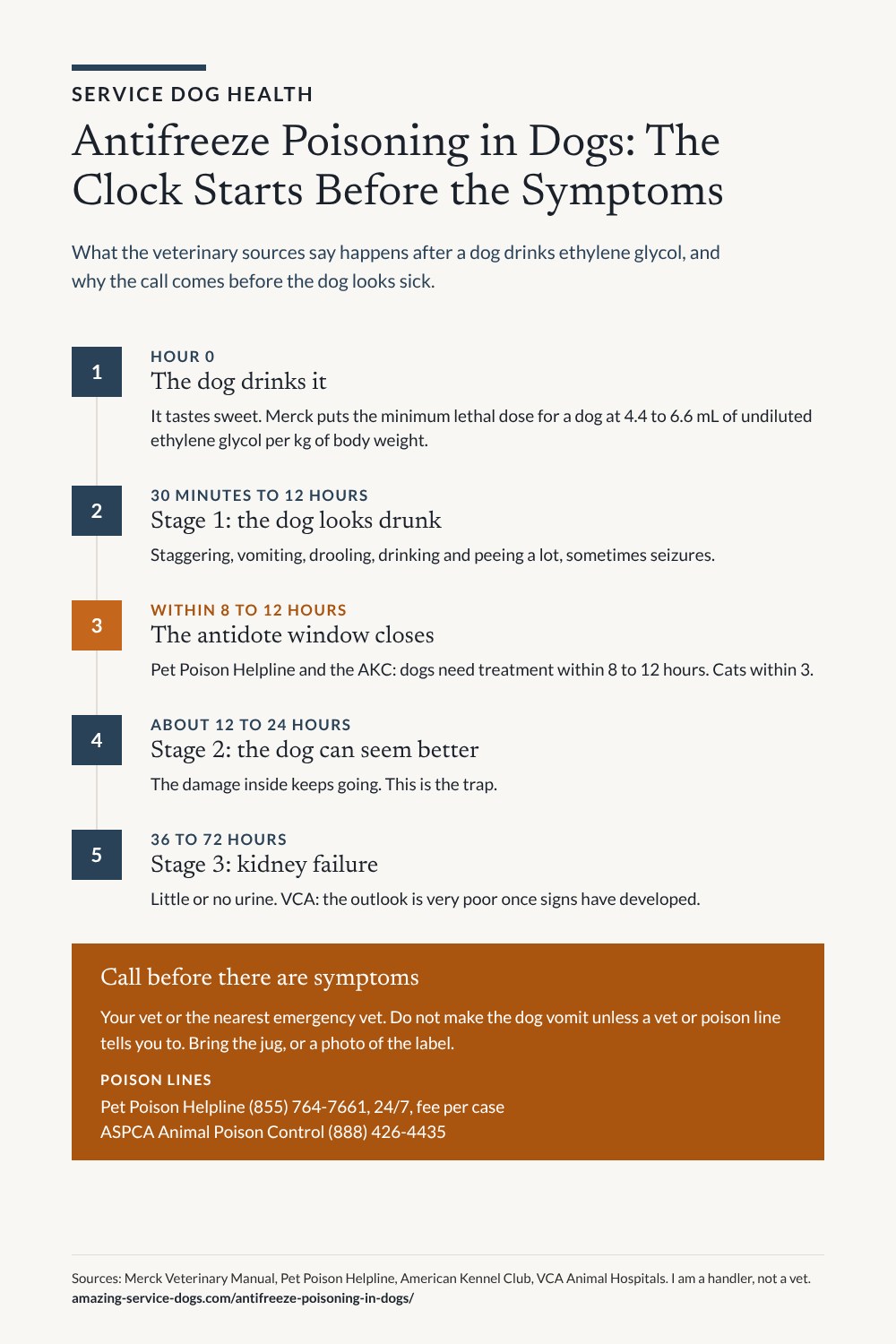
Stage 2 is the trap. Dr. Klein tells the AKC the improvement is usually temporary. A dog that wobbled at supper and seems fine at bedtime is still inside the window.
The ASPCA says problems “may start within a couple of hours of ingestion,” that pets can be seriously ill at six to twelve hours, and that early signs can be missed. VCA puts it plainly: “A delay in treatment of ethylene glycol poisoning usually results in death,” and “The prognosis is very poor once clinical signs have developed.” Merck explains why. Once the kidneys are failing, the antidote “is of little benefit,” because by then most of the ethylene glycol has already been metabolized.
What the veterinary sources say to do first
This is what the vets and the poison lines say. Your vet or a poison line makes the call for your dog, and I am not going to pretend otherwise.
Call before there are symptoms. Your own vet or the nearest emergency vet, and a poison line on the way. Pet Poison Helpline is (855) 764-7661, open 24/7, and it charges a fee per case. ASPCA Animal Poison Control is (888) 426-4435. Both numbers are worth having in your phone before the night you need them.
Watch the clock. Pet Poison Helpline: “Dogs should receive this treatment within 8-12 hours after ingesting the antifreeze,” and cats “within 3 hours after exposure for it to be effective.” Dr. Klein says the same thing for dogs: treated within eight to 12 hours, “or else the antidote will be ineffective.”
Do not make the dog vomit on your own. The AKC says not to induce vomiting without talking to a vet or poison control first. Ethylene glycol absorbs fast, so it may not help, and a dog that is already staggering can choke. Merck says vomiting “should not be induced in a dog or cat exhibiting neurologic signs because of increased risk of aspiration,” and that activated charcoal “is not likely to decrease absorption.”
Bring the jug, or a photo of the label. petMD notes that antifreeze sold for RVs, boats and cabins often contains propylene glycol instead, and says “it’s important to determine the type before treatment begins.”
Know that there is a test. VCA says some clinics have an in-house blood test for ethylene glycol. Merck says the point-of-care test should be run “between 1 and 10–14 hours after ingestion,” which is one more reason the early call matters.
If you have never sat in an emergency vet’s waiting room with a dog, I wrote about what that room is like on the page about a service dog attacked by another dog. What insurance does and does not cover for the dog itself is in does insurance pay for a service dog.
The bitter taste and the “pet safe” label
On December 13, 2012, the Humane Society Legislative Fund and the Consumer Specialty Products Association announced that makers would add “bitter-tasting denatonium benzoate” to consumer antifreeze and engine coolant “in all 50 states and the District of Columbia.” Seventeen states already required it. Oregon was first, with a law in effect since 1991.
That was a good change. It is also why a lot of people think the problem is solved. Merck’s line on it: “the products still may be palatable to some animals.” A bitter taste may put some dogs off. Merck is clear that it does not put off all of them.
Then there is “pet safe” antifreeze, made with propylene glycol. The ASPCA says it “has a much wider margin of safety,” and in the same article says to keep pets away from all chemicals, pet safe antifreeze included. petMD says the two glycols “pose very different risks if ingested,” which is why the vet needs to know which one it was.
Who benefits from you believing the jug is safe now? A bitter taste and a “pet safe” label both make a product easier to buy and easier to stop thinking about. Neither one is a promise in the veterinarians’ own words, and the vets’ own words are the ones on this page.
What the AKC says to change at home
From the AKC’s prevention list:
- Use antifreeze made with propylene glycol where you can.
- Keep any antifreeze in sealed, leak-proof containers your dog cannot reach.
- Check the garage floor and driveway regularly for fluid leaking from vehicles.
- Take used antifreeze to a household hazardous waste program.
- If a toilet has antifreeze in it to keep it from freezing, keep the lid down and the bathroom door closed.
That last one matters for anyone who winterizes an RV or a cabin. Pet Poison Helpline lists winterized RV plumbing, toilets included, as one of the places pets find it.
What I don’t know
I am not a veterinarian. I cannot tell you how much is too much for your dog, whether your dog drank any, or what treatment it needs. That is your vet’s call, and the poison lines exist for exactly that question.
I also cannot tell you how many dogs this happens to. The Humane Society Legislative Fund estimated “10,000 to 90,000 animals poisoned each year” in its 2012 announcement. That is an estimate from an advocacy group, a range nine times wide, not a count. I could not find a national count in any of the sources on this page, and I do not know whether bittering has moved the number since.
The test I would leave you with
If you find a wet spot on the garage floor or the driveway and nobody washed anything, treat it as antifreeze until you know it isn’t. And if your dog was near it and you cannot account for the last few hours, the phone call comes before the wait.
Frequently asked questions
How much antifreeze is toxic to a dog?
The Merck Veterinary Manual puts the minimum lethal dose of undiluted ethylene glycol at 4.4 to 6.6 mL per kilogram for dogs. By my arithmetic that is about 3 to 4 tablespoons for a 20-pound dog and a little over half a cup to just under a cup for a 70-pound dog. A 50/50 coolant mix takes roughly twice as much.
How long does it take for antifreeze to affect a dog?
Signs can start within 30 minutes and up to 12 hours, and look like drunkenness. Between about 12 and 24 hours the dog may seem better while damage continues. Kidney failure follows at 36 to 72 hours in dogs, according to Pet Poison Helpline and the AKC.
Can a dog survive antifreeze poisoning?
The veterinary sources tie survival to time. Pet Poison Helpline says dogs should receive the antidote within 8 to 12 hours of drinking antifreeze. VCA says the prognosis is very poor once clinical signs have developed, and Merck says the antidote is of little benefit once the kidneys are failing.
Is pet safe antifreeze safe for dogs?
Pet safe antifreeze is made with propylene glycol, which the ASPCA says has a much wider margin of safety than ethylene glycol. The ASPCA still says to keep pets away from it, and petMD says the vet needs to know which type a dog swallowed before treatment begins.
Should I make my dog throw up if it drank antifreeze?
The AKC says not to induce vomiting without first talking to a vet or a poison control line. Ethylene glycol absorbs quickly, so vomiting may not help, and Merck warns that a dog showing neurologic signs such as staggering can inhale the vomit.
I am a veteran and a service dog handler, not a lawyer and not a clinician, and nothing here is legal or medical advice. Every link above goes to the regulation, the agency or the study itself, so you never have to take my word for it.
Sources
Every source below was opened and re-read on 27 October 2026.
- Merck Veterinary Manual, Tabatha Regehr, DVM — Ethylene Glycol Toxicosis in Animals
- Pet Poison Helpline — Antifreeze Poisoning in Pets
- Pet Poison Helpline — Antifreeze
- VCA Animal Hospitals — Ethylene Glycol Poisoning in Dogs
- American Kennel Club — Antifreeze Poisoning in Dogs: What to Know
- ASPCA — Digging Deeper: Getting the Facts on the Dangers of Antifreeze and Your Pets
- petMD — Antifreeze Poisoning in Dogs: Symptoms, Treatment, and Prevention
- Humane Society Legislative Fund — Antifreeze and Engine Coolant Being Bittered Nationwide