

Updated September 28, 2026first published December 18, 2018Rewritten in full against the current regulations
Most pages about mobility service dogs are breed lists. You land looking for what these dogs actually do, and you get grooming schedules.
So here is the list first, and then the part almost nobody publishes: what the work does to the dog, and how big, how old, and how sound a dog has to be before it is safe to ask.
One thing up front, because it shapes what follows. I have been a service dog handler for twelve years, but I am not a full-time mobility handler. My dog Mr. Big has counterbalanced me on a bad knee and he hits the accessible door button when there is one. That’s it. Plenty of teams do far more than that every day, and I went and read the veterinary guidelines rather than guess at their lives. Where something is mine, I’ll say so. Where it’s sourced, it’s linked.
Skip to the free mobility dog size calculator — enter your weight, and your hand height if you have a tape measure, and it works out the published minimum dog size for light, moderate and heavy mobility work.
What a mobility service dog actually does
The useful way to sort these tasks is not by how impressive they look. It’s by whether the dog is carrying any of your weight.
That single distinction decides how big the dog has to be, how old it has to be before it starts, and what it will cost the dog’s body over a working life. Most pages blur the two together. Keep them apart and the whole subject gets simpler.
Group one: tasks that put no load on the dog
This is the larger group, and for a lot of people it is the whole job. It is also the group that matters most in chronic, fluctuating conditions where the limit is fatigue and joint pain rather than a fixed loss of function — service dogs for lupus works through one of those in detail.
Retrieval
- Picking up dropped items — keys, phone, cane, wallet, remote
- Fetching a named object from another room
- Carrying an item and delivering it to another person
- Bringing a cordless phone or a medication bag on command
- Clean-up tasks — putting objects into a basket or drawer
Doors, switches and buttons
- Nosing or pawing the accessible door button
- Pressing elevator buttons
- Opening a door by pulling a strap on the handle
- Closing doors and drawers with a nose or paw
- Turning lights on and off
- Opening cabinets and the refrigerator with a tug strap
Around the house
- Pulling socks, shoes, or a sleeve off — undressing assistance
- Dragging a laundry basket
- Loading and unloading a dryer
- Stripping bedding
Getting help
- Finding a specific person in the building and leading them back
- Alerting to a doorbell, alarm, or timer
- Fetching a phone after a fall
- Activating a call-for-help device
In public
- Blocking — standing across your front to hold space
- Covering — standing behind you
- Standing steady beside you in a queue so nobody crowds your feet
- Assistance in a public restroom
None of that requires a large dog. A 30-pound dog can retrieve keys and hit a door button all day and be fine at twelve. If your list of needs sits entirely in this group, you have far more freedom in choosing a dog than any breed list will tell you, and you should read why size matters for this task before assuming you need something enormous.
Group two: tasks that put your weight on the dog
These are the ones that come with conditions attached.
Counterbalance — you rest a hand on a rigid harness handle and the dog provides a steady point of resistance while you walk or catch your balance. The dog is not holding you up; it is giving you something that doesn’t move.
Forward momentum pull — the dog pulls gently and steadily into the harness to help you get moving, or up an incline, when starting a step is the hard part.
Bracing — the dog stands square and takes downward pressure while you push off, stand up, or steady yourself. This is the task that gets argued about, and the rest of this article explains why.
Wheelchair pulling — hauling a manual chair on a flat surface, or helping up a curb cut or a mild slope.
Transfer assistance — bracing while you move between chair and bed, chair and toilet, or into and out of a bath.
Stair work — pulling, then bracing, on each step.
Every one of those puts force through the dog’s shoulders, spine, hips and elbows. Which is the whole reason the second half of this article exists.
The International Association of Assistance Dog Partners describes counterbalance work as the partner pushing down on a rigid handle “as if it were a cane.” Hold on to that phrase. It comes back.
The thing I see most often, and it’s bad
Handlers using a regular pet harness for mobility work. Or worse, a leash — hauling on the collar to get themselves up off a chair. A leash is not mobility equipment and was never meant to be, though the law does require one in most situations for reasons that have nothing to do with load.
I always wonder about that dog’s neck and back. And it is almost always somebody a great deal bigger than their dog.
There is no gentle way to put this: a flat collar and a leash transmit your entire body weight through a dog’s cervical spine. A pet harness with a padded grab handle puts it across the withers and shoulder blades, which are not built to take downward load. Neither one distributes anything. They just move the damage around.
How big the dog has to be
Here is where the old version of this page was worst. It said a mobility dog needs to be “a minimum of 22 inches tall and weigh a minimum of 55 lbs.” For bracing and wheelchair work, that is not close.
The Minimum and Reasonable Mobility Dog Guidelines, revised March 2024, set it out by type of work:
| Type of work | Minimum size |
|---|---|
| Every mobility dog — the guidelines’ general minimum, before any brace or harness work | 60 lb, 22″ at the withers, 18 to 24 months old |
| Light assistance — guiding and light contact through the handle. No bracing, no routine pulling. | 50 lb, 22″ at the withers, and no more than 8″ between the dog and your hand |
| Moderate assistance — counterbalance and momentum pulling | 60 lb, 24″ or taller, 2 years old, with a rigid handle of 6″ or less |
| Heavy assistance — routine pulling, occasional bracing | 24″ or taller, and the dog must weigh at least 50% of the handler’s weight |
Yes, the light-work figure is lower than the general minimum. The guidelines say both, so I’m showing you both.
Height matters as much as weight, and gets discussed less. The handle has to reach your hand while you are standing upright. The guidelines put a number on it: for light work, no more than 8 inches between the dog’s height and your hand; for moderate and heavy work, a rigid handle no taller than 6 inches. If you are stooping to reach it, you are already off balance before the dog does anything, and you have made a stability aid into a fall risk.
A worked example from my own life. Mr. Big was 105 pounds in his prime — a big, solid, powerful dog by any ordinary measure. He was still not tall enough, to do real mobility work for me. He could counterbalance me now and then on a bad knee.
He could not have been my brace, and I would not have asked him to be.
If a 105-pound dog isn’t automatically big enough, “55 pounds” was never a real number.
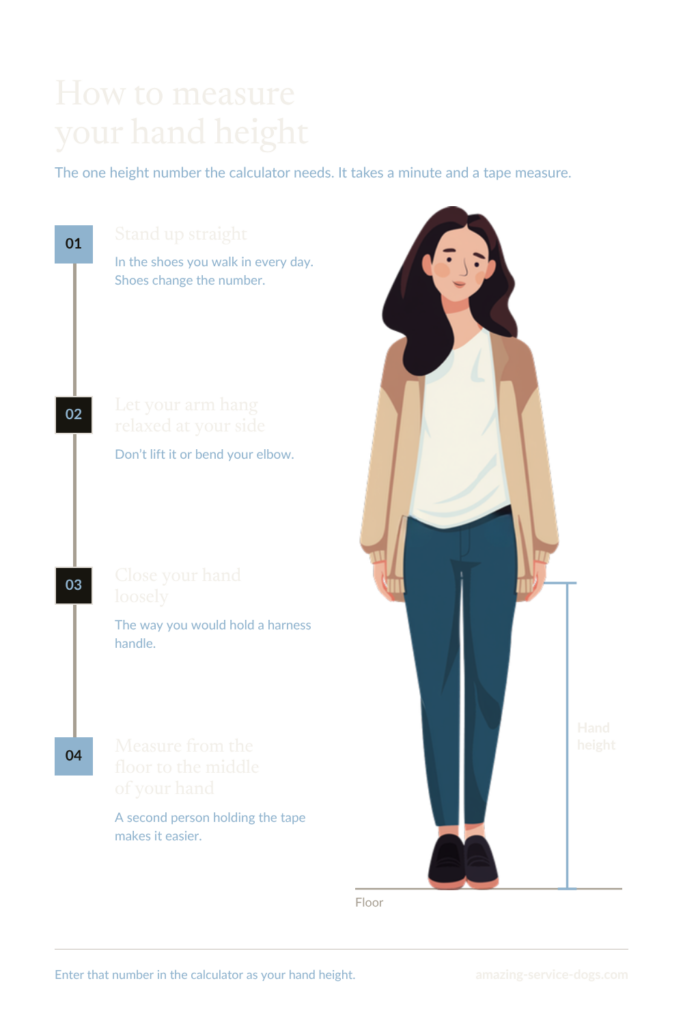
The free calculator on this page works out the minimum dog weight, height and age for light, moderate and heavy mobility work, from your weight and your hand height. Heavy assistance is the tier that depends most on you: the guidelines require a dog weighing at least half what you weigh, and never under 60 pounds. Your hand height sets how tall the dog needs to be, and the graphic below shows how to measure it. It states the published guideline and nothing more — it does not assess a dog, and it asks nothing about your disability.
Free tool
Mobility dog size calculator
Enter your own weight, and your hand height if you have a tape measure handy. This works out the published minimum dog size for light, moderate and heavy mobility work, using the Mobility Dog Resource Group guidelines revised in March 2024. It asks nothing else about you.
Enter your own weight above to see the published minimums worked out.
A minimum is a floor, not clearance.
Every number above is the smallest size the guidelines consider reasonable for that kind of work. Reaching it does not mean a particular dog should do the work.
No load-bearing work before the dog is physically mature. The guidelines set a minimum of 18 to 24 months, depending on breed, and two years for moderate and heavy work. Larger breeds need longer. Pulling, counterbalance and bracing all wait until then.
Orthopedic screening comes before the work, not after it.
The guidelines call for x-rays of the hips and lower back, elbows and shoulders, with OFA or PennHIP review strongly recommended and scores that should be good to excellent. For the shoulder tendons they recommend ultrasound instead of x-rays. Screening x-rays are repeated every one to two years after age six. The dog should be evaluated and cleared for work by a qualified specialized veterinarian, such as one in canine sports medicine or rehabilitation.
This calculator states a published guideline. It does not assess your dog. Whether a particular dog should brace or counterbalance a particular person is a question for a mobility-experienced trainer and a veterinarian, not a website.
Where these numbers come from
Every figure is taken from the Minimum and Reasonable Mobility Dog Guidelines, revised 23 March 2024, published by the Mobility Dog Resource Group.
- Minimum for every mobility dog: 18 to 24 months old, a recommended 60 pounds and 22 inches at the withers, body condition 4 to 5 out of 9, specialist veterinary clearance, and a custom-fitted mobility harness.
- Light assistance (guiding, light leading, light contact through the handle, no bracing or routine pulling): 50 pounds or more, 22 inches or taller, no more than 8 inches between the dog's height and your hand, and a handle that flexes.
- Moderate assistance (counterbalance and momentum pulling): 2 years old, 60 pounds or more, 24 inches or taller, with a rigid bracing handle of 6 inches or less.
- Heavy assistance (routine pulling and occasional bracing): the same, and the dog is at least 50 percent of the partner's weight. Bracing only with a rigid metal handle of 6 inches or less, only for a moment, only with the dog standing square, and never while the dog is moving.
The two things this tool works out for you. Half your weight, for heavy assistance, never set below the 60-pound figure. And from your hand height, the shortest dog that keeps the gap to your hand within the guidelines' 8 inches for light work, or within a 6-inch rigid handle for moderate and heavy work. The handle figure assumes the grip meets your hand while you stand upright with your arm relaxed. Holding the handle higher needs a taller dog, so read it as a floor.
One thing the guidelines say two ways. Their general minimum recommends 60 pounds for every mobility dog. Their best practice for light work lists 50 pounds or more. This tool shows both and does not choose between them.
The Mobility Dog Resource Group is a 501(c)(3) nonprofit. Contributing editors and advisors include founding members Jane Schappell and Katrina Boldry; Elle De Ford, DVM, PhD; Cindy Otto, DVM, PhD; Sasha Foster, MS, CCRT; and Colorado State University's Small Animal Orthopedic Medicine and Mobility service at the J.L. Voss Veterinary Teaching Hospital.
Nothing here is sent anywhere. This calculator runs entirely inside your own browser. No figures you type are transmitted, saved, or stored, not by us and not by anyone. Close the page and it is gone.
Who wrote those guidelines, and why I’m citing them
Ordinarily I don’t take numbers from an organization I haven’t checked. This one holds up.
The Mobility Dog Resource Group is a 501(c)(3) nonprofit. Donations fund mobility dog harnesses and specialty veterinary assessments. Contributing editors and advisors include Cindy Otto, DVM, PhD, of the Penn Vet Working Dog Center, Elle De Ford, DVM, PhD, canine rehabilitation specialist Sasha Foster, CCRT, and Colorado State University’s Small Animal Orthopedic Medicine and Mobility program at the J.L. Voss Veterinary Teaching Hospital.
That is veterinary orthopedic specialists at a teaching hospital, writing down what a dog’s joints can survive.
As far as I can find, not one page currently ranking for this subject cites them.
Age: not before two, and this shouldn’t be controversial
No load-bearing work until the dog’s growth plates have closed — the guidelines say a minimum of 18 to 24 months, with large breeds “generally ready for full work at two years of age.”
Atlas Assistance Dogs puts it in one sentence: “Applying too much weight or pressure on a growing dog can seriously harm the dog.”
Honestly, I don’t understand how this is a debate.
Using a dog for mobility before two is like entering a kindergartner in a strongman competition.
It doesn’t work, and the reason it doesn’t work is not that the child lacks enthusiasm.
You can train everything else from day one. Obedience, retrieval, doors, buttons, manners in public, settling under a table — all of it, starting at eight weeks. Just not the weight.
The screening nobody mentions
Before any load-bearing work, the guidelines call for:
- Radiographs of hips and lower back, plus elbow and shoulder evaluation
- OFA or PennHIP review, with scores that “should be good to excellent”
- Ultrasound for shoulder tendons — x-rays don’t show them
- Clearance by a qualified specialized veterinarian, such as one trained in canine sports medicine or rehabilitation
- Re-screening every one to two years after age six
That is a real expense and I’m not going to pretend otherwise. But consider what you are deciding. You are choosing whether to put your body weight on this animal for the next eight years. Finding out about hip dysplasia at four, after two years of bracing, is worse for both of you than finding out at two.
The part that changed how I’d choose a dog
Mobility work needs a big dog. Big dogs die younger. And the dog can’t start until two.
So the honest number isn’t life expectancy. It’s life expectancy minus two — the years you actually get after the dog is physically ready. And it’s fewer still, because retirement comes before the end of a dog’s life.
Using McMillan et al. (2024) in Scientific Reports — 584,734 dogs, the largest study of its kind:
| Breed | Median life expectancy | Years after skeletal maturity |
|---|---|---|
| Poodle* | 14.0 | 12.0 |
| Golden Retriever | 13.2 | 11.2 |
| Labrador Retriever | 13.1 | 11.1 |
| German Shepherd | 11.3 | 9.3 |
| Rottweiler | 10.6 | 8.6 |
| Great Dane | 10.6 | 8.6 |
| Bernese Mountain Dog | 10.1 | 8.1 |
*One caveat, and it matters. The study did not separate Poodles by size. That 14.0 covers Standard, Miniature and Toy together, and smaller dogs live longer — so the Standard Poodle’s true figure is lower than 14.0. It is still a long-lived breed at that size. It is not a fourteen-year one.
Look at the Bernese Mountain Dog against the Labrador. That’s four years.
Bernese get recommended for mobility work constantly — big, gentle, strong, and they photograph beautifully. What doesn’t get said is that you will be burying one at ten, having worked it for six or seven years, and then waiting another two years for its replacement to grow up.
For a companion dog, four years is heartbreak. For a mobility dog it is also four years of your independence, and a two-year gap you have to plan for and fund. Retirement comes before the end of the dog’s life, and for a mobility dog it comes earlier than for most, because the day the dog’s joints can’t take the load safely is the day the work stops — whatever the dog thinks about it.
None of this makes a Bernese the wrong dog. It makes it a decision you should get to make with the number in front of you.
Breeds, sorted by what you need them for
Not a ranking. What matters is the match between the dog and your actual task list. If a golden is on your shortlist, the orthopedic risk that decides whether one finishes the career is covered in golden retrievers as service dogs.
If you need heavy bracing and transfer work. You need 24 inches or more, at least half your body weight (never under 60 pounds), and excellent orthopedic scores. Labrador Retriever, Golden Retriever, Standard Poodle, Bernese Mountain Dog, Newfoundland, Rottweiler, Greater Swiss Mountain Dog. Go in knowing that the giant breeds carry the shortest working lives — worth reading on the giant breeds before committing.
If you need counterbalance and momentum only. More room here. Labrador, Golden, Standard Poodle, German Shepherd, Doberman, Boxer — the working middle. The Standard Poodle deserves a much closer look than it usually gets: large enough for the work, low-shedding, and among the longest-lived breeds at that size. It normally shows up on these lists as an afterthought for people with allergies.
If you need wheelchair pulling. Strength and structure over height. Labrador, Golden, Standard Poodle, Rottweiler, Bernese, Newfoundland.
If your list is entirely retrieval, doors and buttons. Almost anything trainable and steady in public. Size is close to irrelevant. Choose for temperament, health and lifespan instead — choosing a breed for the work goes into that properly.
What I’m not going to do is tell you a breed is temperamentally unsuited to this. The previous version of this page said certain breeds “generally possess aggressive behavior” and named fighting and guard dogs. That’s the same generalization the Department of Justice says cannot be used against a service dog, and it isn’t how you assess a mobility candidate anyway. You assess this dog: structure, soundness, stability, and whether it can hold a stand-stay while somebody leans on it.
The harness, and what it really costs
A mobility harness is medical equipment. The guidelines require it to be custom-fitted, designed for the specific work, and built to distribute force away from the withers, shoulders and spine.
- Heavy assistance needs a rigid vertical handle, no more than 6 inches from the dog’s back to the grip
- Light assistance handles should flex, not lock rigid
- Neither is a pet harness with a padded loop sewn on
My own experience, for what it’s worth. I never bought a purpose-built mobility harness. I had an off-the-shelf harness modified for Mr. Big — and even that small amount of work was expensive, because it takes somebody who knows how to measure and fit a dog properly. That skill is the cost. The nylon isn’t.
The test to apply before you buy anything. A $40 harness with a rigid handle, sold online, with no measurements taken and no veterinary sign-off, is being sold to you by people who will not be treating your dog’s shoulder in three years. If nobody asked for your dog’s measurements, you are buying a bag, not mobility equipment.
A properly fitted mobility harness runs into the hundreds of dollars, and that is a genuine barrier for a lot of disabled people on fixed incomes. Pretending otherwise helps nobody. The Mobility Dog Resource Group runs funds for harnesses and specialist veterinary assessments for teams who can’t cover it — worth asking about before you settle for something unsafe.
What the law says, briefly
Under the ADA, a service animal can be “any breed and any size of dog”. No certification. No registration. No professional training program required — you may train your own. Staff may ask only two questions: whether the dog is required because of a disability, and what work or task it has been trained to perform. A dog can be removed only if it is out of control or not housebroken.
Here is the distinction that matters on this page and nowhere else on this site. The law sets no minimum size. Physics does. Nothing in the ADA will stop you partnering with a 40-pound dog for bracing work. Your dog’s shoulders will. Those are two entirely separate questions and it is worth being clear which one you’re asking.
If you’re still working out whether you qualify at all, that’s the legal test for a service dog. And because large dogs draw more challenges than small ones, it’s worth knowing what to do if you’re denied access.
A note on where this information comes from. Searching for what the ADA requires of a service dog returns, on the first screen of results, at least three sites that sell registrations, certificates or ID cards. There is no registry in the ADA. They exist to sell you a document for a right the law already gives you free. Before you believe any page on this subject — including this one — look at who owns it and what they’re selling. Federal regulations are published free at ada.gov.
For veterans
The VA does not buy you a dog. It does cover a good deal else, and this is underused.
Per the VA’s service dog benefits fact sheet, an approved veteran gets comprehensive veterinary care — preventive visits, dental, screenings, urgent care, prescriptions, chronic illness treatment — plus the harness and leash, and travel costs to attend handler training.
The dog must come from an organization accredited by Assistance Dogs International (ADI) or the International Guide Dog Federation (IGDF), and the VA is explicit that “there should be no charge for the dog or the associated training.”
The route is: enroll at a VA Medical Center, then ask your primary care provider for a specialist referral.
Program dog or owner-trained
A program dog from an ADI-accredited nonprofit is normally donated, not sold. The organization raises the money; you are typically asked for an application fee or a fundraising commitment, not the $25,000 the dog cost to produce. Waits commonly run two to five years. The dog arrives task-trained, health-screened and matched to your size.
If someone quotes you a price of $20,000 to $50,000 for a mobility dog, check their accreditation first. Accredited programs are listed publicly by Assistance Dogs International. A high price is not evidence of quality, and there is no shortage of operations charging disabled people premium rates for dogs that wash out. The full breakdown, route by route, is in how much a service dog really costs.
Owner-training is legal and it is what many people do. Understand what you’re taking on for mobility specifically: you are sourcing a structurally sound puppy, waiting two years before any load-bearing work, paying for orthopedic screening, and commissioning a fitted harness — all before the dog does the thing you need it for. The training is the easy part. The waiting and the vetting are not.
Frequently asked questions
What tasks do mobility service dogs perform?
They fall into two groups. Non-load-bearing tasks include retrieving dropped items, opening and closing doors, pressing accessible door and elevator buttons, turning lights on and off, removing socks and clothing, dragging laundry, fetching a phone, and finding another person for help. Load-bearing tasks include counterbalance, forward momentum pull, bracing, wheelchair pulling, transfer assistance between chair and bed, and stair work. Only the second group requires a large dog.
How big does a mobility service dog need to be?
It depends on the work. The guidelines set a general minimum of 60 pounds and 22 inches at the withers for any mobility dog. Light assistance with no bracing lists 50 pounds or more and 22 inches. Moderate assistance, meaning counterbalance and momentum pulling, needs 60 pounds and 24 inches. Heavy assistance involving routine pulling and bracing needs a dog 24 inches or taller weighing at least half what the handler weighs. Height matters as much as weight — the harness handle has to reach your hand while you stand upright.
The free mobility dog size calculator on this page works that out from your own weight and hand height, for every tier.
How old does a dog have to be for mobility work?
Not before 18 to 24 months, and for large breeds generally not before two years, when the growth plates have closed and the skeleton is fully developed. Loading a growing dog can cause permanent joint damage. Everything else — obedience, retrieval, door work, public access manners — can and should be trained from puppyhood.
Is bracing safe for a service dog?
Only within limits. The published guidelines allow bracing momentarily and occasionally, with no more than a few pounds of pressure, and only while the dog is standing square and still — never in motion, and never in a way that pushes the dog off balance. A dog is not a substitute for durable medical equipment like a cane, crutch or walker. If you need continuous weight-bearing support, you need equipment as well as a dog.
Can a small dog be a mobility service dog?
For non-load-bearing tasks, yes. A small dog can retrieve dropped items, press accessible buttons, fetch a phone and summon help. What a small dog cannot safely do is carry any part of your weight — no bracing, no counterbalance, no pulling. The ADA sets no size limit, but the dog’s skeleton does.
What health testing should a mobility dog have?
Radiographs of the hips and lower back, elbow and shoulder evaluation, and OFA or PennHIP review with scores in the good to excellent range. Shoulder tendons need ultrasound rather than x-ray. The assessment should come from a vet trained in canine sports medicine or rehabilitation. Screening should be repeated every one to two years after age six.
How much does a mobility service dog cost?
A dog from an ADI-accredited nonprofit is usually donated rather than sold, with an application fee or fundraising commitment instead of a purchase price, and waits of two to five years. Owner-training shifts the cost to sourcing a sound dog, orthopedic screening, professional training help and a fitted harness that runs into the hundreds. Prices of $20,000 or more from unaccredited sellers should be checked against Assistance Dogs International’s public list of accredited programs.
Do I need a special harness for mobility work?
Yes, if the dog carries any of your weight. A pet harness with a grab handle is not mobility equipment and neither is a leash and collar — both put your body weight through the dog’s neck or shoulder blades. A mobility harness must be custom-fitted and built to spread force away from the withers, shoulders and spine, with a rigid handle no more than six inches from the dog’s back for heavy assistance work.
I’m a service dog handler of twelve years with a knee that gives out, not a veterinarian and not a full-time mobility handler. The size, age, screening and harness standards on this page come from the Mobility Dog Resource Group’s March 2024 guidelines, written with veterinary specialists at Colorado State University and the Penn Vet Working Dog Center. Life expectancy figures come from McMillan et al. (2024) in Scientific Reports. Task descriptions draw on the International Association of Assistance Dog Partners and Atlas Assistance Dogs. Every source is linked above, and none of them sell dogs, gear or certificates. If something here is wrong — particularly if you do this work daily and I’ve got a detail off — tell me and I’ll fix it and note that I did.