
Published October 21, 2026Checked against the current regulations
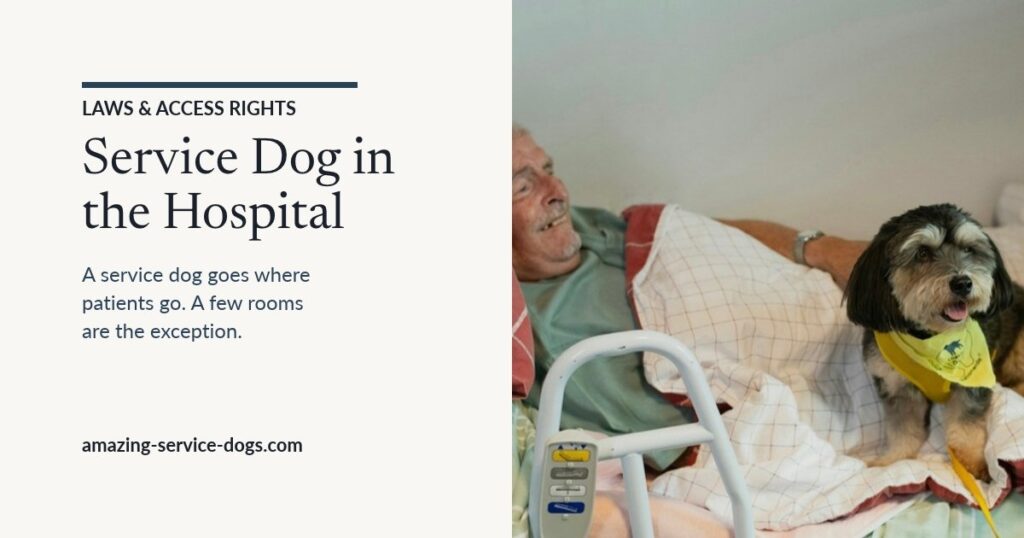
A service dog in the hospital has the same right to be there as you do: the patient room, the exam room, the cafeteria and the hallway to radiology. The Department of Justice says it in one line. The exceptions are real but narrow, and they are rooms, not whole hospitals. What changes when you are admitted is not where the dog may go. It is who takes care of the dog when you cannot.
That second question is the one most pages skip, and it is the one that matters at 0200 when you are on a gurney. This page covers both, in the regulators’ own words, and where to send a complaint if a hospital gets it wrong. For the federal rules this all sits on, start with ADA service dog laws, and for what each state adds on top, service dog laws by state.
Where the dog may go in a hospital
The Department of Justice’s service animal FAQ, asked whether a hospital must let a service animal into a patient room:
“Generally, yes. Service animals must be allowed in patient rooms and anywhere else in the hospital the public and patients are allowed to go. They cannot be excluded on the grounds that staff can provide the same services.”
Read the last sentence twice. A nurse who can fetch your dropped phone does not replace the dog that was trained to.
i was hospitalized and had no problems bringing Mr. Big with me into my VA hospital stay.
The regulation behind that depends on who owns the hospital:
| Hospital | Federal law | Regulation |
| City, county, state or university hospital | ADA Title II | 28 CFR 35.136 |
| Private or nonprofit hospital, clinic, doctor’s office | ADA Title III | 28 CFR 36.302(c) |
| Any of them that takes federal money | Section 504 too | Enforced by HHS |
The wording in both regulations matches where it counts. The dog goes into “all areas” where “members of the public, program participants, clients, customers, patrons, or invitees, as relevant, are allowed to go,” under 28 CFR 36.302(c)(7). The Department of Justice’s own example list for hospitals is “patient rooms, clinics, cafeterias, or examination rooms.”
The rooms that can be off limits
There are exceptions, and they are specific. The Department of Justice: “it may be appropriate to exclude a service animal from operating rooms or burn units where the animal’s presence may compromise a sterile environment.”
The CDC’s infection control guidelines, written for hospital staff in 2003, draw the same line a little wider. They call it appropriate to exclude a service animal from an operating room “or similar special care areas (e.g., burn units, some ICUs, PE units, and any other area containing equipment critical for life support)” if those areas are treated as “restricted access.”
Then the same guidelines turn around and say this:
- “No evidence suggests that animals pose a more significant risk of transmitting infection than people.”
- If immunocompromised patients can have visitors who do not wear protective gear, “an exclusion of service animals from this area would not be justified.”
So the test is not whether the word “sterile” can be said out loud. It is whether the room is actually run as a restricted area, for everyone.
What “sterile” cost one clinic
In July 2026 the U.S. Attorney’s Office for the Middle District of Florida announced a settlement with a pain management practice that had refused a disabled veteran’s service animal at a follow-up appointment after a hospital stay. The practice cited a “no pets policy” and called its office a “sterile environment.” The settlement:
- $100,000 to the veteran and his wife
- $15,000 civil penalty to the United States
- a written service animal policy, staff training, a “Service Animals Welcome” sign at public entrances, and two years of reporting complaints to the government
Who benefits when a front desk calls an ordinary exam room sterile? Nobody, as it turned out. That one sentence ended in a $115,000 settlement.
What hospital staff may ask, and what they may not
The same two questions as anywhere else, under 28 CFR 36.302(c)(6) for a private hospital and 35.136(f) for a public one:
- Is the animal required because of a disability?
- What work or task has the animal been trained to perform?
Staff “shall not require documentation, such as proof that the animal has been certified, trained, or licensed as a service animal.” In August 2024 the U.S. Attorney’s Office in New Jersey reached an agreement with Hackensack Meridian Health after one of its doctors’ offices refused a person using a service animal at an appointment. The agreement required a written policy at the office, training under Title III, and damages to the person who was turned away.
Two more things a hospital may not do:
- Charge you for the dog. No surcharge, and no requirement “generally not applicable to people without pets,” under 36.302(c)(8). Damage the dog actually causes is the one exception, if the hospital charges everyone for damage.
- Ask what the dog eats. Diet is not one of the two questions. Why that question keeps coming up anyway, and what the infection control rules for therapy dogs say about raw food, is in raw feeding service dogs and public access.
They may ask the dog to leave for two reasons only: it is out of control and you do not take effective action to control it, or it is not housebroken. That is 36.302(c)(2), and it applies in a hospital bed the same as in a grocery store.
Who takes care of the dog while you are admitted
This is the part that catches people, and it is the negative side of the whole page.
The regulation is short: “A public accommodation is not responsible for the care or supervision of a service animal.” The Department of Justice spells out what care means: “toileting, feeding, and grooming and veterinary care.” None of that becomes the nurses’ job because you were admitted.
So the Department of Justice lays out the order of things when a patient cannot care for the dog:
- First, you arrange it. A family member or friend can come to the hospital to care for the dog, “as it is always preferable that the service animal and its handler not be separated,” or keep the dog during your stay.
- Only then, the hospital. If you cannot care for the dog and cannot arrange for someone else to, “the hospital may place the dog in a boarding facility until the patient is released, or make other appropriate arrangements.”
- And you get the first chance. “However, the hospital must give the patient the opportunity to make arrangements for the dog’s care before taking such steps.”
The issue that I was having was my own mobility during my stay, so taking him out to potty was a bit stressful for me.
The CDC guidelines add the clinical side. Staff and the patient “should discuss both the possible need for the service animal to be separated from its handler for a period of time during non-emergency care” and “an alternate plan of care for the service animal in the event the patient is unable or unwilling to provide that care.”
Here is what I do not know, and could not find in any federal source: who pays for that boarding. The guidance says the hospital “may place the dog.” It does not say on whose bill. If that matters to you, and on a fixed income it matters, ask the hospital before you need the answer.
The portable fix is a name and a phone number. Somebody who can come get your dog, written down where a paramedic or a nurse will find it.
The ambulance
The Department of Justice on whether a service animal rides in an ambulance with its handler: “Generally, yes.” The exception is crowding: if the dog “would interfere with the emergency medical staff’s ability to treat the patient, staff should make other arrangements to have the dog transported to the hospital.”
That “other arrangements” line is a duty, not a shrug. In 2018 the U.S. Attorney’s Office for the Western District of Kentucky settled with Hardin County EMS over a complaint that it “failed to modify its policies and procedures to permit use of a service animal inside an ambulance.” The county agreed to adopt grievance procedures and put every employee who deals with the public through a two-hour training on the ADA, including service animals.
Visiting someone in the hospital
You do not have to be the patient. The Department of Justice’s answer covers anywhere “the public and patients are allowed to go,” and the public includes visitors. If the person you are visiting is in a room the public can enter, your service dog can go too, under the same two questions and the same restricted-area exceptions.
Emotional support animals and therapy dogs are different
An emotional support animal is not a service animal under the ADA. The federal definition at 28 CFR 35.104 says emotional support, comfort and companionship “do not constitute work or tasks.” So a hospital has no ADA duty to admit one, and many hospitals run their own animal visitation rules instead.
A therapy dog is a third thing again: a dog that visits patients through a hospital’s own volunteer program, under that program’s rules. Those rules are much stricter than anything that applies to a service dog, and the reason why is in service dog vs therapy dog. If you are not sure which one your dog is, emotional support animal vs service dog draws the line.
Who to report it to
Two federal doors, and you can knock on both:
- The Department of Justice takes ADA complaints through the Civil Rights Division’s online report form or by mail. Its own page is honest about the limit: “Unfortunately, we cannot investigate every complaint.” It says review can take up to three months.
- The HHS Office for Civil Rights enforces Section 504 against health care providers that take federal money, which HHS says includes “many hospitals, nursing homes, mental health centers and human service programs.” Its deadline is the one to watch: a complaint must be filed “within 180 days of when you knew that the act or omission complained of occurred.” HHS takes complaints through its online portal, by mail or by email.
Write it down while it is fresh: the date, the time, the unit, the name or badge of the person who refused, and what they said, word for word. The full doorway playbook is in what to do if your service dog is denied access.
When I searched this on 20 October 2026, one of the results on Google’s first page was a Facebook thread where the top answer says the law will not help you in a hospital. A pain clinic that paid $115,000 and a county EMS that rewrote its policies say otherwise.
Who benefits from you believing you need paperwork
On that same search, a site that sells service dog registrations ranked on page one with its own hospital guide. A hospital “shall not require documentation, such as proof that the animal has been certified, trained, or licensed as a service animal.” That sentence is in the federal regulation for every private hospital in the country, and it costs nothing to read. More on how the registration business works is in how to spot a fake service dog.
The test to carry in with you
When someone in scrubs says the dog cannot come, ask one thing: is this a room the public or patients are allowed into? If yes, the dog goes, unless it is out of control or not housebroken. If it is an operating room, a burn unit or another restricted area where visitors gown up, the dog may wait outside. And if you are being admitted, the second question is yours to answer before anyone else does: who is coming for the dog?
Frequently asked questions
Can your service dog go to the hospital with you?
Yes. The Department of Justice says service animals must be allowed in patient rooms and anywhere else in the hospital the public and patients are allowed to go, and that they cannot be excluded because staff could provide the same services. Operating rooms, burn units and other restricted-access areas are the narrow exceptions.
Can a hospital make my service dog leave?
Only for two reasons under the ADA: the dog is out of control and the handler does not take effective action to control it, or the dog is not housebroken. A hospital may also keep a service dog out of specific restricted areas such as operating rooms and burn units, but not out of patient rooms, clinics, exam rooms or cafeterias.
Who takes care of my service dog if I am admitted to the hospital?
You do, or someone you arrange. The hospital is not responsible for the dog’s care. A family member or friend can come to care for the dog or keep it. If you cannot care for it and cannot arrange anyone, the hospital may board the dog, but it must give you the chance to make arrangements first.
Can a hospital ask for proof that my dog is a service dog?
No. Staff may ask only whether the dog is required because of a disability and what work or task it has been trained to perform. The ADA regulations say a hospital shall not require documentation such as proof that the animal has been certified, trained or licensed. In 2024 a New Jersey health system agreed to retrain staff after a refusal.
Can a hospital deny an emotional support animal?
Yes. An emotional support animal is not a service animal under the ADA, because the federal definition says emotional support, comfort and companionship are not work or tasks. A hospital has no ADA duty to admit one, though it may allow animals under its own visitor or pet therapy policy. A trained service dog is treated differently.
Can my service dog ride in the ambulance with me?
Generally, yes. The Department of Justice says a service dog should ride with its handler unless the space is so crowded that the dog would interfere with the crew treating the patient. In that case staff should make other arrangements to get the dog to the hospital, not simply leave it behind.
Where do I report a hospital that refused my service dog?
Two places. The Department of Justice takes ADA complaints through the Civil Rights Division’s online report, though it cannot investigate every one. The HHS Office for Civil Rights takes Section 504 complaints against providers that receive federal money, and those must be filed within 180 days of when you knew about the refusal.
I am a veteran and a service dog handler, not a lawyer and not a clinician, and nothing here is legal or medical advice. Every link above goes to the regulation, the agency or the study itself, so you never have to take my word for it.
Sources
Every source below was opened and re-read on 20 October 2026.
- U.S. Department of Justice — Frequently Asked Questions about Service Animals and the ADA
- U.S. Department of Justice — ADA Requirements: Service Animals
- Electronic Code of Federal Regulations — 28 CFR 36.302, Modifications in policies, practices, or procedures (ADA Title III)
- Electronic Code of Federal Regulations — 28 CFR 35.136, Service animals (ADA Title II)
- Electronic Code of Federal Regulations — 28 CFR 35.104, Definitions (service animal)
- Centers for Disease Control and Prevention — Guidelines for Environmental Infection Control in Health-Care Facilities: Animals in Health-Care Facilities
- U.S. Attorney’s Office, Middle District of Florida — Tampa Bay Pain Management Clinic to Pay $115,000 for Discriminating Against Disabled Veteran
- U.S. Attorney’s Office, District of New Jersey — Agreement with Hackensack Meridian Health on Service Animals
- U.S. Attorney’s Office, Western District of Kentucky — Hardin County EMS Enters Settlement with the United States
- U.S. Department of Justice — File a Complaint
- U.S. Department of Health and Human Services, Office for Civil Rights — Filing a Civil Rights Complaint
- U.S. Department of Health and Human Services, Office for Civil Rights — Know the Rights That Protect Individuals with Disabilities from Discrimination