
Published October 13, 2026Checked against the current regulations
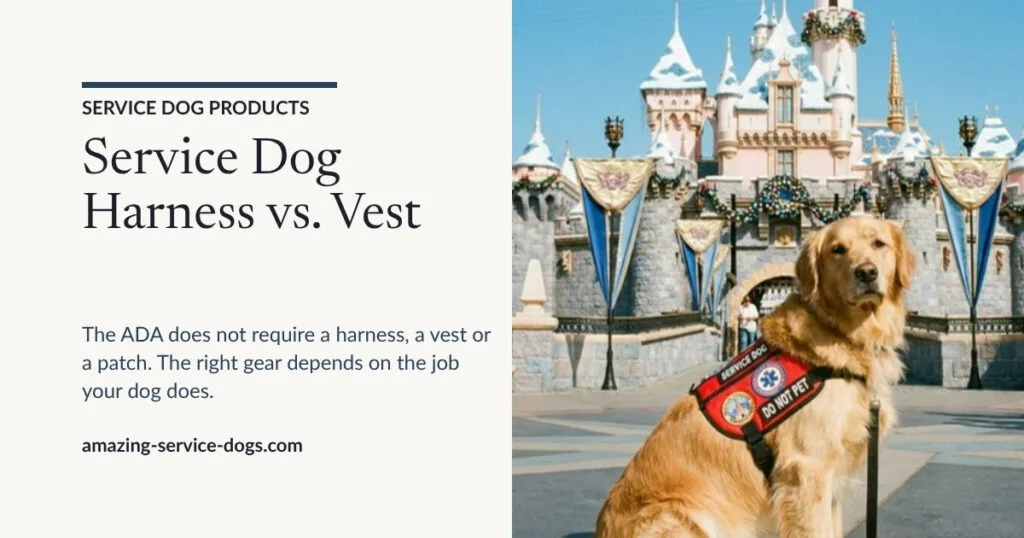
If you are shopping for a service dog harness, here is the short answer before anything else: the law does not require one. No harness, no vest, no patch. So the question is not which one makes your dog “official.” It is which piece of gear fits the job your dog actually does, and whether you need gear at all.
That answer is different for a guide dog, a mobility dog, and a dog whose whole job happens at home. And it is very different for a search and rescue dog, which is a working dog but not a service dog, and wears gear for completely different reasons.
I have used one vest on Mr. Big for twelve years, and I had an off-the-shelf harness modified for him once. I have never owned a purpose-built guide or mobility harness, so where this page talks about those, it is built from the published standards and linked, not from my closet.
I am a service dog handler, not a trainer by profession, a vet or a lawyer, and nothing here is professional advice.
Last updated: October 2026
The quick answer: harness or vest?
The Department of Justice says it in one sentence:
The ADA does not require service animals to wear a vest, ID tag, or specific harness.
So the choice is yours, and it comes down to one question: does the gear need to do a job, or just say something?
- If it only needs to say “working dog,” a vest or a simple ID harness does that. Pick whichever fits your dog better.
- If you hold onto it to be guided, you need a guide harness with a handle, issued by the program that trained the dog.
- If any of your weight goes through it, you need a custom-fitted mobility harness. Nothing else is safe.
That is the whole decision. The rest of this page explains each one, and what to watch out for when you buy.
Vest vs. harness, in plain words
A vest sits over the dog’s back and buckles under the chest and belly. It carries patches. It tells people the dog is working, and that is all it does. I wrote up what twelve years did to mine, part by part.
A harness is built around the dog’s chest and shoulders with straps. Some harnesses only carry patches, just like a vest. Others have a handle you hold, and that handle is where the real difference starts.
Here is the part that trips people up. The word “harness” on a listing tells you nothing about what it can safely do. A patch harness and a mobility harness can look alike in a small photo. One is a sign. The other is equipment that carries load.
One more thing. The ADA does say a service animal must be “harnessed, leashed, or tethered” in public places, unless that gear gets in the way of the dog’s work or the handler’s disability prevents it. That is a control rule, not a dress code. A plain leash meets it. I covered that in is a leash necessary for service dogs.
The 3 kinds of service dog harness
1. ID harness (patches, no working handle)
This is a vest in harness form. It has panels for patches, a ring for the leash, and sometimes a soft grab loop on top. It does the same job as a vest: it tells people the dog is working and helps head off questions.
Whether a vest or an ID harness fits your dog better depends on your dog’s shape, so try both on if you can. Either way, it is a communication tool. That soft loop on top is for lifting a small dog into a car or steering, not for leaning on.
2. Guide harness (rigid handle)
A guide harness is what a dog guide for a blind or low vision handler wears. Guide Dogs for the Blind describes it as two parts, a body and a handle, with the handle being “a ‘U’ shaped, fairly rigid rod that has padded leather on the end for you to grip during guidework.”
The handler holds that handle while the dog guides.
This is not a harness you buy off a shelf and train into. Guide Dogs for the Blind issues the harness with the dog, and says the handler works with their instructor to choose the best type of handle.
3. Mobility or brace harness (load bearing)
This is the one that matters most, because getting it wrong hurts the dog.
A mobility harness is for counterbalance, momentum pulling and, within limits, bracing. The Minimum and Reasonable Mobility Dog Guidelines from the Mobility Dog Resource Group set the rules:
- It “shall be custom-fitted to the dog.”
- It “shall be specifically designed for the work the dog will perform.”
- It must spread the force out and avoid “direct pressure on withers, shoulders and spine.”
- For moderate to heavy work and bracing, the handle is rigid metal, 6 inches or less from the dog’s back to your grip.
- For light balance work, the handle should flex to absorb extra motion, not lock rigid.
- No load-bearing work in any harness until the dog is at least 18 to 24 months old.
The size of the dog matters as much as the harness. I covered the size tiers, the age rule and the vet screening in mobility service dogs, and that page has a free calculator that works out the minimum dog size from your weight and hand height.
The only harness experience I have myself is this: I never bought a purpose-built mobility harness. I had an off-the-shelf harness modified for Mr. Big, and even that small job was expensive, because it takes somebody who knows how to measure and fit a dog. That skill is the cost. The nylon isn’t.
If nobody asked for your dog’s measurements, you are buying a bag, not mobility equipment.
Which gear fits which job
| What your dog does | Best gear | Why |
|---|---|---|
| Alerts, tasks at home, psychiatric or medical tasks in public | Vest or ID harness, or nothing | The gear only needs to say “working.” Pick for fit and comfort. |
| Retrieving, doors, buttons | Vest or ID harness | No weight goes through the dog. A tug strap does the door work, not the harness. |
| Guiding a blind or low vision handler | Guide harness with a rigid handle | The handler holds the handle while the dog guides. Issued by the program. |
| Light balance help, no bracing | Mobility harness with a flexible handle, custom-fitted | The guidelines say light work handles should flex. |
| Counterbalance, momentum pull, occasional bracing | Mobility harness with a rigid metal handle, 6 inches or less, custom-fitted | Your weight goes through the dog. It has to be spread away from the shoulders and spine. |
| Small dog, any task | Vest or ID harness | A small dog should never carry any of your weight. More on small service dogs here. |
Can my dog wear both?
Yes. Some handlers put patches on the harness and skip the vest. Some use a thin vest under a working harness. Nothing in the law stops you either way.
The thing to watch is heat and fit. Two layers on a dog in a Texas summer is a lot. And a vest bunched up under a mobility harness can shift the harness off the spots it was fitted to, which defeats the point of having it fitted. If your dog wears a mobility harness, ask whoever fits it before you add anything under it.
What to look for when you buy
These come from what lasted on my own vest, and from what the mobility guidelines require. They apply to any harness or vest.
Fit first. Measure the girth, the widest part of the chest, and check it against the maker’s chart before you order. If your dog is under two or has a broad chest, expect the chest to change. Mine did, and I ended up having the belly band lengthened.
Look at where the straps sit. For any harness that will carry load, the guidelines are clear: no direct pressure on the withers, shoulders or spine.
Handle: know what it is for. A soft loop is for steering or lifting a small dog. A rigid handle is for guiding or mobility work, and only on a harness fitted for that.
Buckles and webbing over shiny extras. On my vest, the plain plastic buckles and webbing have been fine for twelve years. The reflective tape was the first thing to wear out. Reflective trim is nice to have, but buy for the parts that hold the thing on.
Removable patches. Being able to swap IN TRAINING for SERVICE DOG, or take DO NOT PET off, saves buying a second piece of gear.
Washable. Hand washing and hanging to dry has kept mine going. Check what the maker says before it goes anywhere near a dryer.
Ignore anything that sounds official. A harness printed with CERTIFIED or REGISTERED, or sold with an ID card, is selling you a right the law already gives you for free. There is no registry. I went through that in how to identify a fake service dog.
A $40 “mobility harness” with a rigid handle is a red flag. Nobody measured your dog. Nobody checked your height or how far the handle sits from your hand. A properly fitted mobility harness costs a lot more. The Mobility Dog Resource Group, a nonprofit, says donations to it go toward funds for mobility harnesses and specialty vet assessments for teams in need. Ask them before you settle for something unsafe.
I am not linking to any harness on this page. I have not used one I can vouch for, and I don’t recommend things I haven’t used. My rules for that are on my how I review things page.
What search and rescue dogs wear, and why it’s different
A lot of people land on gear pages looking for search and rescue harnesses and vests. So here is the honest version.
A search and rescue dog is not a service dog. Under the ADA, a service animal is a dog “individually trained to do work or perform tasks for an individual with a disability.” A SAR dog works for a search team, not for a disabled handler, so service dog access rights don’t apply to it.
That changes what the gear is for. A service dog’s vest is about the public. A SAR dog’s gear is about being seen and found in the field.
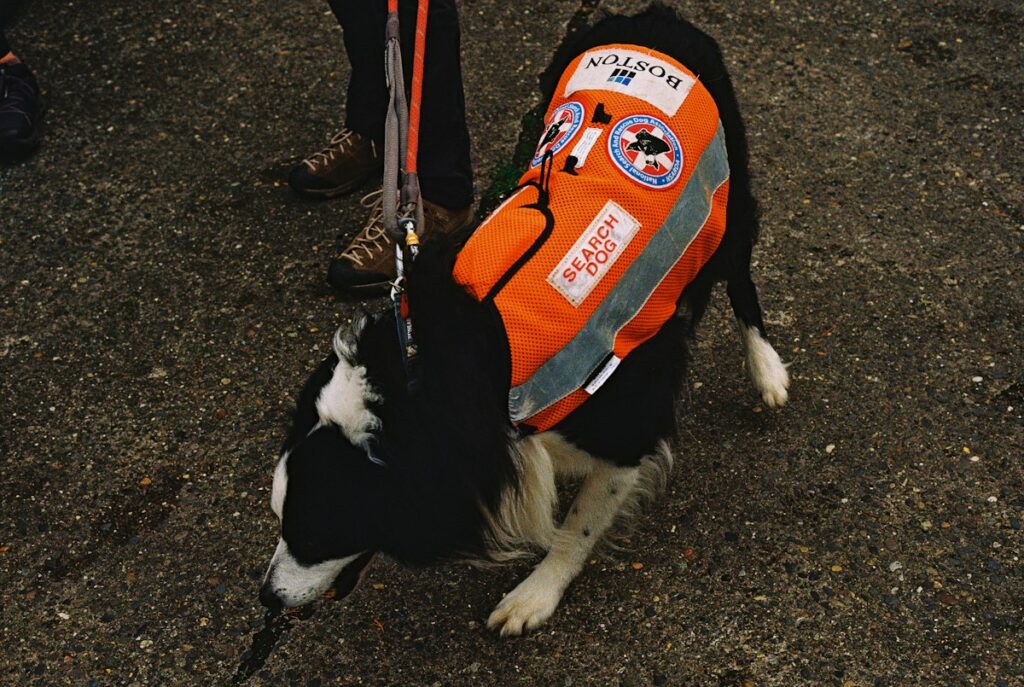
- Bright vests. The SAR group D.A.W.G.S. puts it simply: “Search dogs wear orange safety vests so they can be seen easily.”
- Bells. “Some dogs wear a bell so the handler can hear the dog and know where the dog is searching.”
- Lights. “At night, each dog wears a lighted collar so the dog can be seen.” German Shepherd Search Dogs lists light vests, collar lights, glow sticks and reflective patches for night work.
- No packs. German Shepherd Search Dogs says “Search Dogs do not wear packs as it interferes with their job.” The handler carries the dog’s gear.
So if you have a service dog, SAR gear is the wrong tool. An orange vest with a bell is built to make a dog easy to see and hear in the field, not to tell a store clerk the dog is working. And if you have a SAR dog, a service dog vest won’t give it any public access rights, because the law doesn’t treat it as one.
Frequently asked questions
Do service dogs have to wear a harness?
No. The Department of Justice states that the ADA does not require service animals to wear a vest, ID tag or specific harness. The ADA does require the dog to be harnessed, leashed or tethered in public unless that gets in the way of its work or the handler’s disability, but a plain leash meets that rule.
Is a harness or a vest better for a service dog?
It depends on the job. If the gear only needs to show the dog is working, a vest or an ID harness both do that, so pick whichever fits your dog better. If the handler holds on to be guided or puts weight on the dog, it has to be a guide or mobility harness, fitted for that work.
Can my dog wear a vest and a harness at the same time?
Yes. Nothing in the law stops it. Watch for heat, and if the harness is a fitted mobility harness, ask whoever fitted it before putting a vest underneath, because a bunched vest can shift where the harness sits.
What is a mobility harness for a service dog?
A harness built for counterbalance, momentum pulling and limited bracing. The Mobility Dog Resource Group guidelines say it must be custom-fitted, designed for the specific work, and avoid direct pressure on the withers, shoulders and spine. Heavy work uses a rigid metal handle 6 inches or less from the dog’s back.
Can I use a regular pet harness with a handle for mobility work?
No. A pet harness with a padded handle puts your weight across the dog’s shoulders and spine instead of spreading it out. Mobility work should only be done in a harness designed and fitted for it, and only once the dog is at least 18 to 24 months old.
Should a small service dog wear a vest or a harness?
Either one works for showing the dog is working, so pick whichever fits better. What a small dog should never do is carry any of the handler’s weight, so a small dog never needs a mobility harness.
Is a search and rescue dog a service dog?
No. The ADA defines a service animal as a dog individually trained to do work or perform tasks for an individual with a disability. A search and rescue dog works for a search team, so it does not have service dog access rights, and its bright vest, bell and lights are there so it can be seen and heard in the field.
Does a service dog harness need to say “certified” or “registered”?
No. There is no official registry or certification for service dogs under the ADA, and staff cannot require one. Gear printed with those words is a marketing claim, not a legal one.
Can I just put a service dog vest on my dog?
You can buy one, but the vest does not make your dog a service dog. ADA.gov says a dog wearing a vest is not necessarily a service animal. What counts is training: the dog has to be individually trained to do work or perform tasks for a person with a disability. A pet in a vest is still a pet, and it makes life harder for handlers whose dogs are the real thing. More on that in how to spot a fake service dog.
How do I make my dog a legit service dog?
Through training, not paperwork. Under the ADA, your dog becomes a service dog when you have a disability and the dog is trained to do specific tasks that help with it. No registry, certificate or ID card makes a dog “legit”, and staff cannot ask for one. I walk through the steps in how do I qualify my dog as a service dog.
I am a service dog handler, not a veterinarian, a trainer by profession or a lawyer, and nothing here is professional advice. If your dog will carry any of your weight, talk to a qualified vet and a professional fitter before you buy anything.
Sources
Every source below was read directly on 13 October 2026.
- US Department of Justice, Frequently Asked Questions about Service Animals and the ADA: the definition of a service animal, that the ADA does not require a vest, ID tag or specific harness, that registration cannot be required, and the harnessed, leashed or tethered rule
- ADA.gov, Service Animals: that a dog wearing a vest is not necessarily a service animal
- Mobility Dog Resource Group, Minimum and Reasonable Mobility Dog Guidelines (revised March 2024): custom fitting, handle types and heights, force distribution, and the age minimum for load-bearing work
- Mobility Dog Resource Group, home page: its 501(c)(3) status and the harness and vet assessment funds
- Guide Dogs for the Blind, Equipment class lecture: the parts of a guide harness, the handle, and choosing a handle with an instructor
- D.A.W.G.S. (Disaster And Wilderness Ground Searchers), FAQs: orange safety vests, bells and lighted collars on search dogs
- German Shepherd Search Dogs, Equipment: night visibility gear, and that search dogs do not wear packs