

Updated September 14, 2026first published December 14, 2018Rewritten in full against the current regulations
Yes, you can insure a service dog. Any pet insurer will take one. There is no medical underwriting that turns a task-trained dog away, no service-dog application, and no separate product you have to go looking for.
What you cannot do is insure the thing most people are actually asking about. No policy on the market covers buying the dog or training the dog. Not one, anywhere. Veterinary insurance covers veterinary costs, and only from the day coverage starts.
What it costs. Pet insurance for a dog averaged $676 a year, or about $56 a month, for accident-and-illness cover — the figure the industry publishes for itself through the North American Pet Health Insurance Association, reported by the Insurance Information Institute. That is an average across every dog in the country. Yours will land above or below it depending on four things, and age is the big one.
If you are a veteran approved under 38 CFR 17.148, stop and read the veterans section first. VA is billed for your premiums, copayments and deductibles. The arithmetic on this page is not yours to do.
For everyone else, whether a policy is worth buying comes down to four questions, and the rest of this page is how to answer them with your own dog’s numbers:
- How early can you enroll? This decides more than the price does
- What do the orthopedic and hereditary exclusions say? This is where working dogs get caught
- Can you pay a large vet bill up front and wait to be repaid? Most policies work that way
- What would the same money do in an account of your own?
This page is only about the dog you already have. If your question is whether someone else will pay for the dog in the first place — health insurance, Medicare, the VA, a tax deduction — that is a different question with a different answer, and it is in does insurance pay for a service dog. For what the dog cost to get, see how much does a service dog cost, and if you are still working out whether a dog is the right answer at all, start with do I qualify for a service dog.
What it costs, and what moves the price
The $676 average is a starting point, not a quote. Four things move it, and they move it a long way.
| What moves the price | Which direction, and how much it matters |
|---|---|
| Your dog’s age at enrollment | The single biggest factor. Premiums rise as the dog ages, and a policy first bought on an older dog costs more and excludes more |
| Breed and adult size | Large breeds and purebreds cost more, because hereditary and orthopedic claims are more likely and more expensive |
| Where you live | Priced off local veterinary costs. The same dog and the same policy are not the same price in two states |
| What you choose | Your deductible, your reimbursement percentage and your annual limit. These are yours to set, and they change the premium more than shopping between brands does |
Two things that number does not include. Routine care — vaccinations, dental cleaning, annual bloodwork — is not in an accident-and-illness policy. It is sold as a separate wellness add-on, and a wellness plan is not insurance. It is a payment plan for costs you already know are coming, usually priced at or slightly above what those costs would be anyway.
And the direction of travel matters. Veterinary prices in the United States rose 60% between April 2014 and 2024, a figure taken from a letter two sitting US senators wrote about consolidation in the industry — more on that letter further down this page. Premiums follow veterinary costs. The number you are quoted this year is not the number you will pay in five.
Pet insurance itself is growing quickly. NAPHIA counted 7.6 million pets insured across North America at the end of 2025, up 8.5% in a single year. Dogs are roughly 80% of insured pets. That growth is worth knowing for one reason only: it tells you this is a market with a lot of new money in it, and a lot of new marketing aimed at you.
First, the thing nobody selling it will tell you
There is no such thing as service dog insurance.
There is ordinary pet insurance. Some insurers will add a working-animal endorsement. Nothing on the market is designed around a task-trained dog, priced for one, or underwritten with one in mind.
That matters for two reasons. Any page quoting you a figure for “service dog insurance” as though it were a distinct product is quoting something that does not exist. And every policy you will be offered was written with a pet on the sofa in mind, not a dog that works several hours a day in public.
This is not a reason to skip insurance. It is a reason to read the policy differently from the way a pet owner would, because the exclusions that barely touch a house dog land squarely on a working one. That is what the rest of this page is for.
Veterans: this page may not be yours to worry about
If you are a veteran approved for service dog benefits under 38 CFR 17.148, none of the arithmetic on this page is yours to do. VA provides a commercial veterinary insurance policy and is billed for the premiums, copayments and deductibles. There is no monthly cost to weigh, because you are not paying it. There is no reimbursement problem, because you are not fronting it.
What the VA benefit does not cover, and this catches people out: food, grooming, boarding, over-the-counter medication, nail trimming, and non-sedated dental work. Those are the costs that arrive every month rather than once in a crisis.
So keep a private fund anyway. Not for catastrophe — that is covered — but for the steady monthly running costs that the benefit was never meant to touch.
Two things worth being clear about, because they are the most commonly misunderstood parts of the whole benefit. VA does not buy you a dog. And the benefit requires a dog from an organization accredited by Assistance Dogs International or the International Guide Dog Federation, which means a self-trained team gets none of it. The eligibility rules are narrower than most people expect and wider than most people are told, and they are set out properly in how veterans get their own service dog.
The five words that decide everything
Pet insurance is a business built on definitions, and four or five of them decide whether your policy pays or does not. They are not hidden — regulators have written them down.
The NAIC Pet Insurance Model Act, adopted in 2022 by the National Association of Insurance Commissioners, defines them like this:
| Term | What it means in the model act |
|---|---|
| Preexisting condition | A condition where, before the policy started or during a waiting period, a vet gave medical advice, the pet received treatment, or the pet had signs or symptoms directly related to the condition |
| Waiting period | The time that must pass before some or all of the coverage begins |
| Hereditary disorder | An abnormality genetically transmitted from parent to offspring that may cause illness |
| Congenital anomaly | A condition present from birth, inherited or environmental, that may cause illness |
| Chronic condition | A condition that can be treated or managed, but not cured |
Read the preexisting definition again, because it is broader than almost everyone assumes.
It does not require a diagnosis. It does not require treatment. Signs or symptoms are enough, and so is a vet having given advice. A note in your dog’s record from two years ago saying he was stiff after a long day can sit behind a claim for hip dysplasia later on.
That single definition is why the value of a policy is decided almost entirely by how early you bought it, and why a policy taken out on a healthy two-year-old is a genuinely different product from the same policy taken out on a six-year-old with a file.
Which dogs are hardest to insure
People ask which breeds are uninsurable, and the answer splits in two depending on which insurance they mean.
For pet health insurance: effectively none. Pet insurers do not decline dogs by breed the way people expect. They price by breed instead. A large breed or a purebred costs more because hereditary and orthopedic claims are more likely and more expensive when they come. And they exclude by breed indirectly, through the hereditary and congenital clauses — which is the same thing as a decline for the condition your dog is most likely to get, arriving at claim time rather than at the quote.
So the honest version of the question is not will they take my dog. It is will they pay for the thing my breed actually gets. For a German Shepherd that is hips and elbows. For a Labrador, cruciate ligaments and elbows. For a Great Dane or another giant breed doing counterbalance or bracing work, joints and heart. Ask about that specific condition by name before you enroll.
For liability insurance, breed is a real problem, and it is a different policy. Some homeowners and renters insurers maintain restricted breed lists and will decline or surcharge a household with certain dogs. That is where handlers with bully breeds, Rottweilers, German Shepherds and Dobermans actually run into trouble, and it has nothing to do with veterinary cover.
It also does not change your housing rights. A housing provider cannot refuse a service animal on breed, and an insurer’s list is not a lawful reason to. That subject is handled properly in can a landlord refuse a service dog, and the breed question itself in can a pit bull be a service dog.
Why this lands harder on a working dog
A service dog and a pet do not get the same conditions at the same rates, and the mismatch runs in the wrong direction.
The conditions most likely to end a working career are orthopedic. Hips, elbows, cruciate ligaments, spinal problems. A mobility dog that braces, a large breed doing counterbalance work, any dog doing retrieval on hard floors for years — these are the dogs whose joints are asked for the most.
And orthopedic conditions are exactly what the exclusions above are built around. Hip dysplasia is a hereditary disorder by any definition. Many policies apply a longer waiting period to orthopedic conditions specifically than to anything else. And a dog whose record shows any earlier stiffness, limp or gait comment is a dog with a preexisting-condition argument waiting to be made.
Three things to ask about specifically, because they are where working dogs get caught:
- The orthopedic waiting period. Ask what it is, separately from the general waiting period. If it is six or twelve months, a policy bought today does nothing for a cruciate injury next spring.
- Bilateral conditions. Ask what happens if one side is excluded. On many policies, a problem in one knee or hip before coverage makes the other side preexisting too, because they are treated as one condition.
- Hereditary and congenital cover. Ask whether it is included at all, whether it costs extra, and whether it has its own waiting period.
Get all three in writing before you pay anything. A phone answer is worth nothing at claim time.
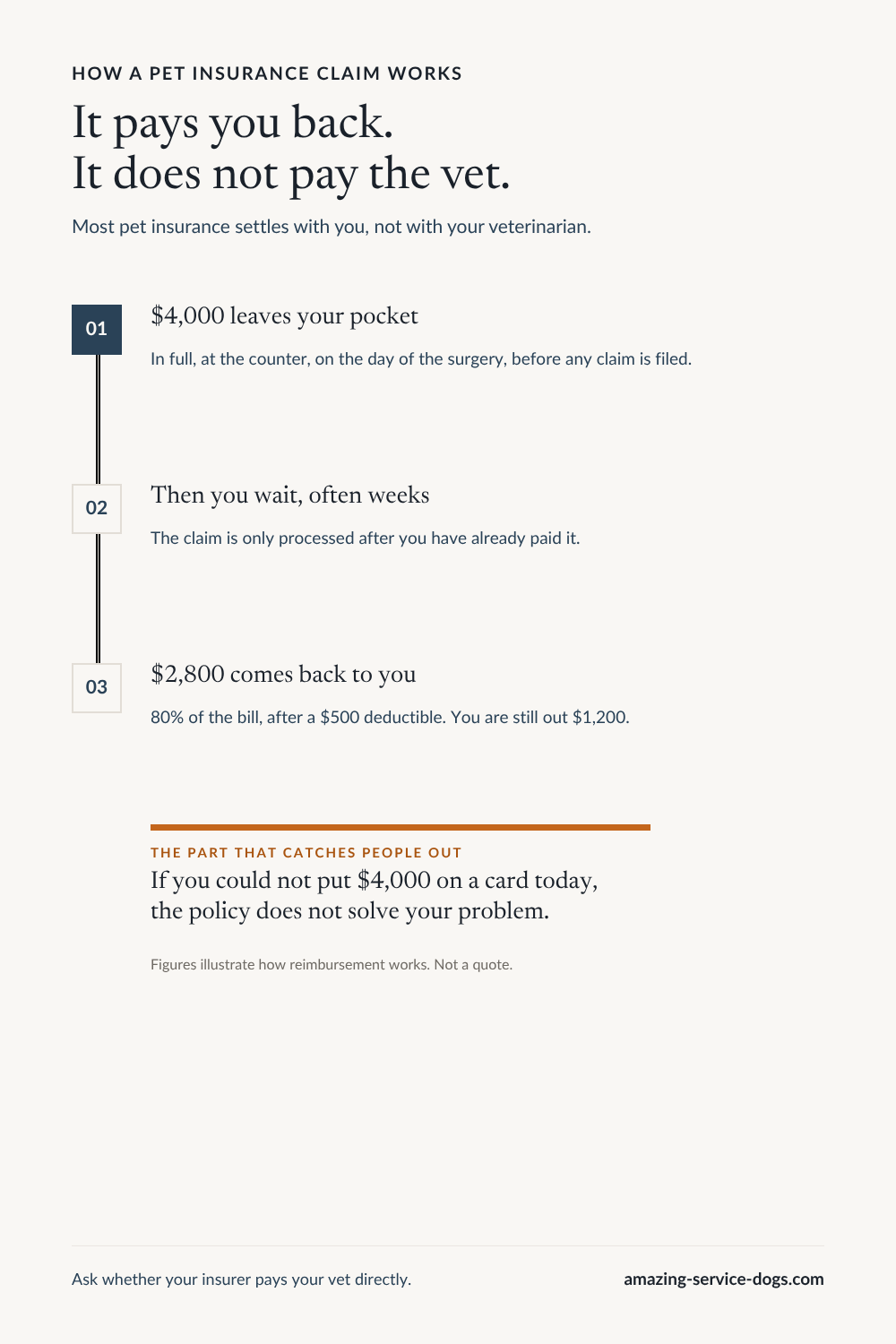
It pays you back. It does not pay the vet.
This is the practical fact that decides the question for a lot of handlers, and it is rarely stated plainly.
Most pet insurance is a reimbursement product. You pay the veterinary bill in full, at the counter, on the day. Then you submit a claim and wait to be paid back, minus your deductible and your share.
So a $4,000 surgery means you find $4,000 first, and a policy paying 80% after a $500 deductible returns roughly $2,800 to you some weeks later. That $4,000 is an illustration rather than a quoted price, but it is not a dramatic one — a cruciate repair or a foreign body removal lands in that territory routinely, and those are among the most common serious surgeries a working dog will face.
If you could not put $4,000 on a card today, a reimbursement policy does not solve the problem you actually have. It softens the aftermath. Some insurers offer direct payment to participating clinics — ask whether yours does, and whether your own vet is one of them. That single question changes what the product is worth to you.
The seven things to check, in order of how much they matter
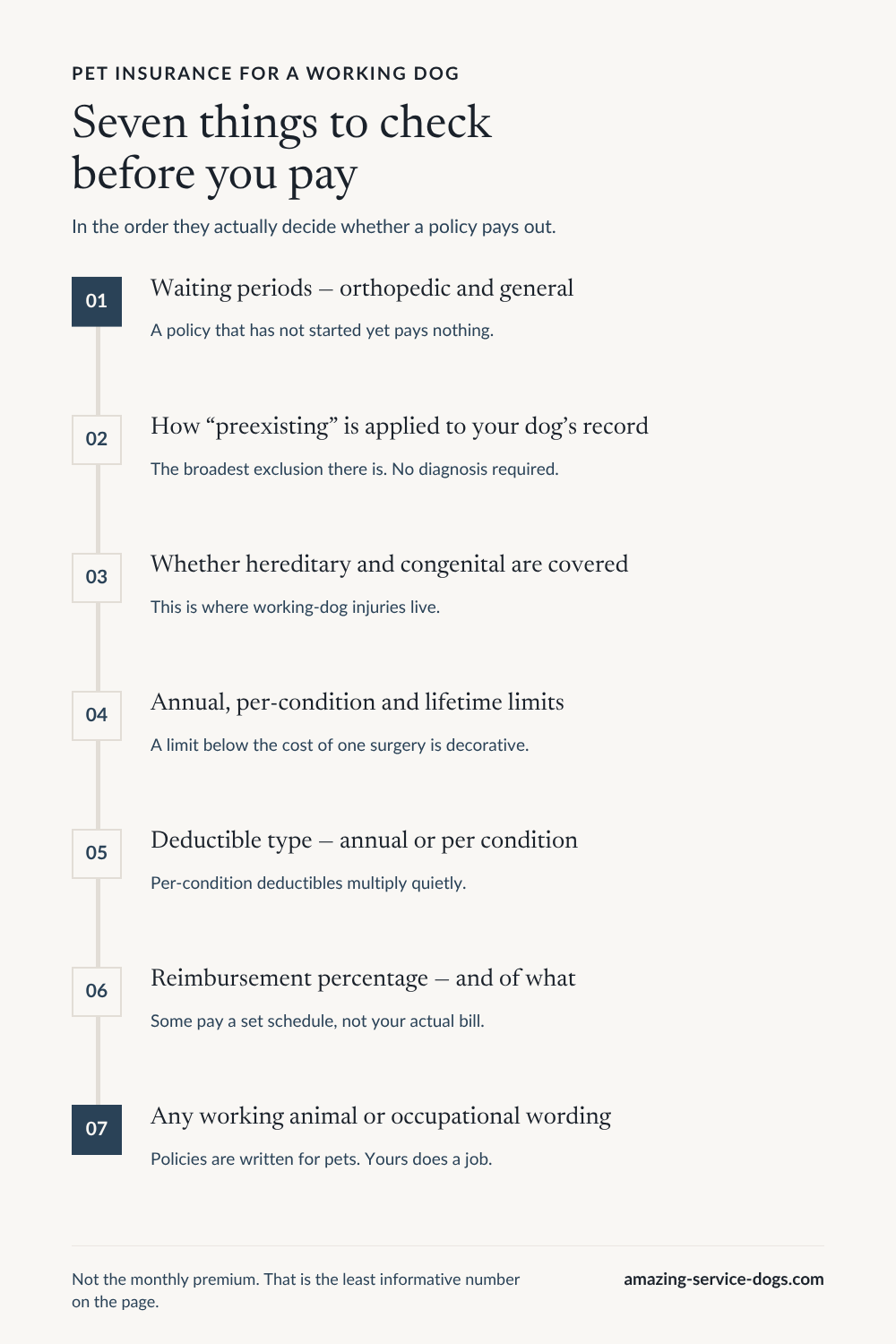
Not the monthly premium. The premium is the least informative number on the page.
| # | What to check | Why it decides things |
|---|---|---|
| 1 | Orthopedic and general waiting periods | A policy that has not started yet pays nothing |
| 2 | How preexisting is applied to your dog’s existing record | The broadest exclusion there is |
| 3 | Whether hereditary and congenital conditions are covered | This is where working-dog injuries live |
| 4 | Annual, per-condition and lifetime limits | A limit below the cost of one surgery is decorative |
| 5 | Deductible type — annual or per condition | Per-condition deductibles multiply quietly |
| 6 | Reimbursement percentage, and of what | Some reimburse a benefit schedule, not your actual bill |
| 7 | Any working animal, task or occupational language | Policies are written for pets. Yours does a job |
On the sixth: there is a real difference between a policy paying 80% of what your vet charged and one paying 80% of what the insurer considers usual and customary. Ask which, and ask for an example.
California requires insurers to disclose that basis, along with waiting periods, deductibles, coinsurance, limits, and whether premiums rise with claims or age — the full list is at California Insurance Code § 12880.2, and other states have adopted similar rules from the NAIC model. Wherever you live, those disclosures exist somewhere in the paperwork. Ask for the page.
Use your free look period. It is a real right.
This one is worth more than it sounds and almost nobody uses it.
The NAIC model act gives an applicant 15 days from receiving the policy to review it and return it for a full refund, provided no claim has been made. California requires 30 days.
That is not a cooling-off gimmick. It is enough time to read the actual policy — not the sales page, the policy — with the seven questions above in your hand, and get your money back if the answers are not what you were told.
Buy it, read it properly, and cancel inside the window if the exclusions do not match the sales pitch. The exact period where you live will be in the documents; California handlers can also see California service dog laws for what else the state adds.
Now do the arithmetic
This is the part that actually answers the question, and it is not complicated.
Work out the true annual cost of the policy:
- Twelve months of premium, at the price it will be next year, not the introductory one
- Plus the deductible
- Plus your share of a claim after reimbursement
Against the $676 national average, a policy that looks like $45 a month today is realistically $700 to $900 of real annual cost by the time the deductible and your share are counted in. Use your own quote, not the average.
Then ask what the same monthly amount would do sitting in a savings account instead, compounding quietly, available for anything.
There is no universal answer, and anyone who gives you one is guessing. Roughly:
Insurance tends to win when the dog is young and clean-recorded, the policy is comprehensive with real limits, and a catastrophic bill would otherwise be unpayable. One cruciate repair or a foreign body surgery can exceed several years of premiums.
Saving tends to win when the policy was bought late, carries exclusions on the exact systems most likely to fail, applies per-condition deductibles, or costs more each year as the dog ages into the years he is most likely to need it.
I am not a financial adviser and this is not financial advice. It is arithmetic, and it is yours to do with your own numbers.
Name the incentive: who owns the vet, and who owns the insurer
There is a reason to do that sum carefully rather than assuming the market has priced it fairly on your behalf.
On 6 August 2024, Senators Elizabeth Warren and Richard Blumenthal wrote to JAB Holding Company about consolidation in veterinary care. The letter is public and it sets out the following:
- Private equity firms spent over $51 billion on veterinary acquisitions between 2017 and 2023
- JAB owns nearly one third of the veterinary clinic marketplace
- Prices for veterinary services rose 60% since April 2014
- The senators raise the concern that owning clinics and pet insurance brands together “may empower JAB to preference its own insurance brands at its clinics”, producing what they call a “false illusion of choosing among separately-owned pet insurance companies”
- They also note customers “may continue to believe their veterinary practice is locally owned”
Separately, the largest veterinary provider in the United States is Mars, Incorporated — the confectionery company — which owns VCA, Banfield and BluePearl, and also owns Royal Canin.
None of that is an allegation of wrongdoing, and no company named here is accused of anything. It is a description of who owns what, taken from a letter written by two sitting United States senators.
But it changes what a quote means. When one corporate parent can own the clinic that sets the price, the insurer that reimburses it, and the food and prescription diet sold at the counter, the appearance of shopping around is not the same thing as shopping around.
Find out who owns your veterinary practice, and who underwrites the policy you are offered. If it is the same name, you are not negotiating between two parties. You are negotiating with one.
The same test does work all over this site — it is the flight version in does insurance pay for a service dog and the registry version in how to identify a fake service dog.
The alternative a lot of handlers use instead
Set the money aside yourself.
A dedicated account, funded every month with what the premium would have cost, does several things no policy does:
- No exclusions. No preexisting condition clause, no hereditary carve-out, no bilateral rule
- No waiting period. It works the day there is money in it
- No age limit, and no premium that climbs as your dog gets older — which matters most in the retirement years, when the bills are largest
- It covers what policies carve out — dental, grooming complications, behavioral work, end-of-life care, and the routine costs that arrive monthly rather than once
- It is yours. If your dog stays healthy, you keep it
It also puts you in charge of what the money is spent on, which is worth more than it sounds. A fund you control is a fund you can decline to spend on something the evidence does not support — do joint supplements work for dogs is one place that question comes up, and prevention that actually works is mostly keeping the dog at the right body condition rather than anything you buy in a tub.
What a fund does not do is protect you in year one, before it has built up. That is the whole trade, honestly stated: insurance converts a small certain cost into protection against a large uncertain one, and a savings account does not. A handler with a young healthy dog and no capacity to absorb a catastrophe may reasonably choose either.
Plenty of experienced handlers do both — a high-deductible policy for catastrophe only, and a fund for everything beneath it.
The HSA question, which is closer than people think
There is no health savings account for a dog. You cannot open one in your dog’s name, and no tax-advantaged account exists for this purpose.
But if you have an HSA-eligible health plan, you may already have most of what you are wishing for. HSA distributions are for “medical care” as defined in Internal Revenue Code section 213(d) — the same statutory definition that puts a guide dog or other service animal into IRS Publication 502. Where your dog’s costs qualify as your own medical expense, they can generally be paid from your HSA with pre-tax dollars.
That is a genuine advantage over a plain savings account, and it is explained more fully in does insurance pay for a service dog. Confirm the specific expense with your plan administrator in writing.
The catch is real: you need an HSA-eligible plan to have an HSA at all, and many people do not. For everyone else the plain account has no tax advantage — and no eligibility rules either.
Frequently asked questions
Can you insure a service dog?
Yes. Any pet insurer will cover a service dog, and there is no separate service dog product you need to find. What no policy covers is buying or training the dog. Veterinary insurance covers veterinary costs only, and only from the day coverage begins. The questions worth asking are not whether they will take your dog but whether the policy pays for the conditions a working dog actually gets.
How much does service dog insurance cost?
There is no separate service dog rate, so you pay ordinary pet insurance prices. Accident-and-illness cover for a dog averaged $676 a year, about $56 a month, according to figures the North American Pet Health Insurance Association publishes and the Insurance Information Institute reports. Your own quote depends mostly on your dog’s age at enrollment, then breed and adult size, where you live, and the deductible and reimbursement percentage you choose. Routine and wellness care is sold separately and is not insurance.
Is pet insurance worth it for a service dog?
It depends on arithmetic only you can do. Add twelve months of premium at next year’s price, plus the deductible, plus your share of a claim, then compare that against saving the same amount monthly in an account with no exclusions, no waiting period and no age limit. Insurance tends to win for a young dog with a clean record and an unaffordable worst case. Saving tends to win for a policy bought late with exclusions on the systems most likely to fail.
Will insurance help pay for a service dog?
Not for the dog itself. No pet insurance policy and no health insurance plan in the United States pays to acquire or train a service dog. Veterinary insurance pays toward the dog’s medical care once coverage has started. Money for acquiring a dog does exist, but it comes from other places — nonprofit programs, pre-tax medical accounts and, for some veterans, the VA. Those routes are set out in does insurance pay for a service dog.
What breed of dog is uninsurable?
For pet health insurance, effectively none. Insurers price by breed rather than declining by it, so large breeds and purebreds cost more because hereditary and orthopedic claims are likelier and more expensive. The restriction people are usually thinking of belongs to homeowners and renters liability insurance, where some insurers keep restricted breed lists that include bully breeds, Rottweilers, German Shepherds and Dobermans. That is a different policy, and it does not override your housing rights.
Is there free insurance for a service dog?
Not as a general benefit. The one real exception is the VA: a veteran approved under 38 CFR 17.148 is given a commercial veterinary insurance policy with VA billed for the premiums, copayments and deductibles. Some assistance dog organizations also cover veterinary costs for dogs they placed, particularly during a dog’s first year, so ask the program that placed your dog what it still covers.
What counts as a preexisting condition for a dog?
Under the NAIC Pet Insurance Model Act, a preexisting condition is one where, before the policy began or during a waiting period, a veterinarian gave medical advice, the pet received treatment, or the pet showed signs or symptoms directly related to the condition. No diagnosis is required. A note about stiffness or a limp in an old record can support an exclusion later, which is why enrolling early matters more than any other factor.
Does pet insurance cover hip dysplasia in a service dog?
Sometimes, and it is the single most important thing to check for a working dog. Hip dysplasia is a hereditary disorder, and policies differ on whether hereditary conditions are covered at all, cost extra, or carry their own longer waiting period. Ask specifically about the orthopedic waiting period and about bilateral conditions, because a problem on one side can make the other side preexisting.
Do I have to pay the vet before insurance pays me?
Usually yes. Most pet insurance is a reimbursement product: you settle the bill in full at the clinic and claim afterwards, receiving your share back weeks later. Some insurers offer direct payment at participating clinics. Ask whether yours does and whether your own veterinarian participates, because on a fixed income that single answer can decide whether the policy is any use.
Can I cancel a pet insurance policy after I read it?
Yes, within the free look period. The NAIC model act provides 15 days from receiving the policy to return it for a full refund if no claim has been made, and California requires 30 days. Use it deliberately: buy the policy, read the actual document against the exclusions you were promised, and cancel inside the window if they do not match.
Does insurance cover the cost of buying a service dog?
No. No veterinary or pet insurance policy covers the purchase or the training of a service dog, and no health insurance plan does either. Insurance of any kind only ever covers the dog’s veterinary costs from the day coverage begins. Where money for acquisition actually exists is a separate subject.
Can I open a health savings account for my service dog?
Not in the dog’s name, and no tax-advantaged account is designed for this. But if you have an HSA-eligible health plan, HSA distributions are for medical care as defined in Internal Revenue Code section 213(d), the same definition that puts a service animal into IRS Publication 502. Where the dog’s costs qualify as your medical expense they can generally be paid from your HSA. Confirm with your plan administrator in writing.
Will my premium go up as my dog gets older?
Very likely, and it is the number that decides whether a policy still exists when you need it. Insurers may raise premiums or reduce coverage based on claim history, the pet’s age, or your location, and they are required to disclose that they do so. Ask what the premium looks like at eight, ten and twelve before you enroll, not after.
Does the VA pay for my service dog insurance?
For an approved veteran under 38 CFR 17.148, yes. VA provides a commercial veterinary insurance policy and is billed for the premiums, copayments and deductibles rather than the veteran. It does not cover food, grooming, boarding, over-the-counter medication, nail trimming or non-sedated dental care, so a private fund for routine costs is still worth keeping.
The short version
Yes, you can insure a service dog, and it costs what ordinary pet insurance costs — around $676 a year on average, and a great deal more or less depending on your dog’s age. There is no separate service dog product, and nothing you can buy covers acquiring or training the dog.
Whether it is worth buying comes down to four things: how early you can enroll, what the orthopedic and hereditary exclusions say, whether you can front a bill and wait to be repaid, and what the same money would do in an account of your own.
Read the policy inside your free look period, not the sales page. Ask who owns the clinic and who owns the insurer. And if you are a veteran approved under 38 CFR 17.148, none of it is yours to pay for.
A policy is only worth what it pays for the condition your dog is actually going to get, at the age your dog is actually going to get it.
Sources: NAPHIA State of the Industry, Insurance Information Institute, Facts + Statistics: Pet Ownership and Insurance, NAIC Pet Insurance Model Act, California Insurance Code § 12880.2, Senators Warren and Blumenthal to JAB Holding Company, 6 August 2024, 38 CFR 17.148, IRS Publication 502, IRS Publication 969.